Lesson reading
live
21 min
Start with the lesson question, connect the representations, and test the model with evidence.
Inspect the opening phenomenon
Predict what changes, then name the evidence.
Apply in the lab
Name the evidence before reading the answer.
Read only what helps
Then use the lab and recall check.
More when needed
Transcript and resources stay available below.
Course progress
Proton Transfer, Buffers, and Titrations
Decision challenge
Use the opening example to make a prediction, identify evidence, and explain which model supports it.
Predict pH at half-equivalence when pKa is 4.76.
A conjugate pair resists limited pH change; equal pair amounts give pH equal to pKa.
Before
Predict pH at half-equivalence when pKa is 4.76.
During
Track what consumes added hydronium and hydroxide.
After
Explain why a weak-acid equivalence point is basic.
Lesson reading
live
21 min
Video script
draft
Transcript fallback
available
courses/ap-chemistry/modules/08-acids-and-bases/lessons/01-proton-transfer-buffers-and-titrations/video-transcript.md
Supervised Microscale Buffer-Capacity Investigation
approved
1 hr
Mastery check
live
6 questions / 15 min
Buffers do not lock pH. They absorb a limited chemical challenge. A weak acid, HA, removes added hydroxide; its conjugate base, A minus, removes added hydronium. Their ratio sets pH: pH equals p K a plus the log of A minus over HA. At half-equivalence in a weak-acid titration, the pair amounts are equal, the log term is zero, and pH equals p K a. But at equivalence, only the conjugate base remains, so its hydrolysis makes the solution basic. Retrieval pause: if p K a is 4.76, what is pH at half-equivalence? 4.76. Remember: buffer means resistance, not immunity. Continue the free AP Chemistry lesson at EduQuest.
Reading lab
Connect the lesson's words, diagrams, graphs, evidence, and equations.
How can one equilibrium model explain pH, buffer action, and the shape of a titration curve?
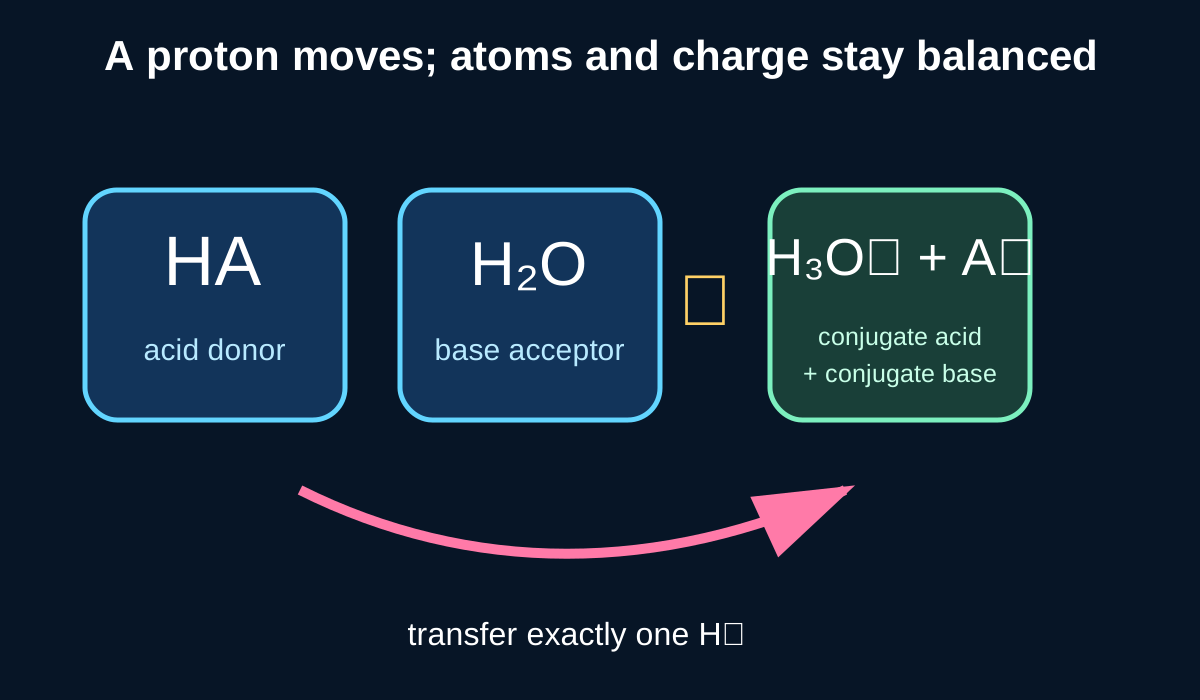
A Brønsted–Lowry acid donates a proton and a base accepts one. In and are conjugate pairs. Charge and atoms are conserved. Water is omitted from At , and . Neutral means ; pH 7 is neutral only when .
For acetic acid with , let : The approximation gives and . Because , the approximation is reasonable. A strong acid is defined by extensive ionization, not by high concentration.
A buffer contains meaningful amounts of a weak acid and its conjugate base. Added is consumed by ; added is consumed by . For an ideal dilute buffer, This relationship describes equilibrium after stoichiometric neutralization is handled. It does not mean a buffer prevents all pH change, and it fails after a component is nearly exhausted.
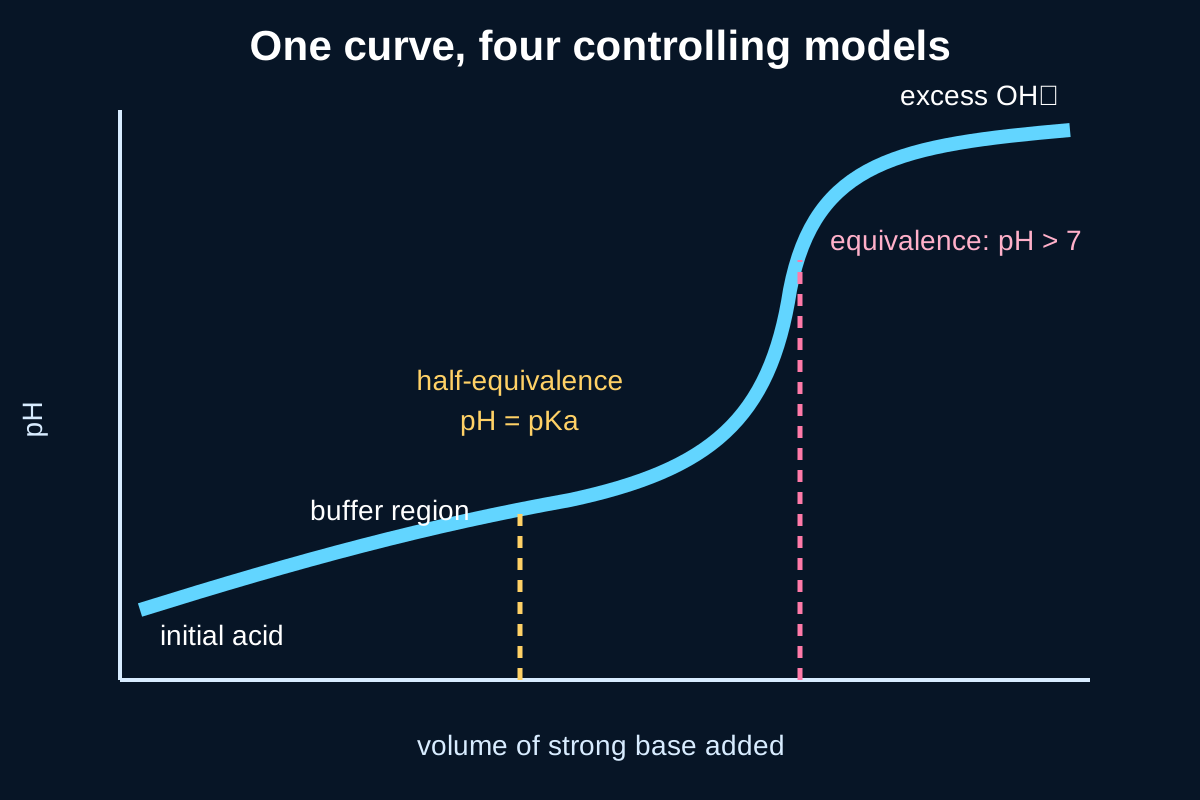
In a weak-acid/strong-base titration: before equivalence, neutralization stoichiometry determines remaining and produced ; at half-equivalence, so ; at equivalence, conjugate-base hydrolysis makes the solution basic; after equivalence, excess strong base controls pH. Choose an indicator whose transition interval lies within the steep equivalence-region change.
Complete the supervised microscale buffer-capacity investigation in lab.md. Online work does not replace supervised hands-on AP laboratory time.
Determine how conjugate-pair ratio and total concentration affect buffer pH and capacity.
How do conjugate-pair ratio and total concentration affect buffer pH and capacity?
Teacher supervision is required. Wear splash goggles, compatible gloves, lab coat or apron, long pants, and closed-toe shoes. Work in the laboratory with normal room ventilation; use local exhaust if the SDS or site chemical-hygiene plan requires it for any reagent. Use only teacher-prepared dilute solutions (recommended acetic acid/sodium acetate and HCl/NaOH). Consult SDS and the site chemical-hygiene plan. Never pipette by mouth. Rinse skin or eyes with water for at least 15 minutes and notify the instructor; use the facility spill procedure rather than improvising neutralization. Collect all mixtures in the labeled aqueous acid/base waste container unless the instructor’s approved local procedure states otherwise. Do not drain-dispose by assumption.
Do not perform this investigation at home or without a trained instructor and the site’s required controls. Stop immediately and notify the instructor after any splash, spill, damaged container, probe failure, missing PPE, or instruction to stop; do not resume until the instructor has assessed the condition.
Use net ionic equations to explain each response. Distinguish buffer ratio from total capacity, identify uncertainty sources, and justify whether the evidence supports the claim that dilution leaves the ideal initial ratio nearly unchanged while decreasing capacity.
Equal-ratio buffers begin near pKa. Dilution changes the initial ideal ratio little but reduces the amount of added acid or base required for a large pH change.
Use measured amounts and Ka to predict each pH after stoichiometric neutralization, then compare residuals with observations.
Students who cannot handle reagents may direct a trained partner, analyze teacher-collected data, or use a teacher-approved simulation. This alternative supports access but does not independently satisfy supervised hands-on AP laboratory requirements.