Lesson reading
live
14 min
Start with the lesson question, connect the representations, and test the model with evidence.
Inspect the opening phenomenon
Predict what changes, then name the evidence.
Apply in the lab
Name the evidence before reading the answer.
Read only what helps
Then use the lab and recall check.
More when needed
Transcript and resources stay available below.
Course progress
Representing and Quantifying Reactions
Decision challenge
Use the opening example to make a prediction, identify evidence, and explain which model supports it.
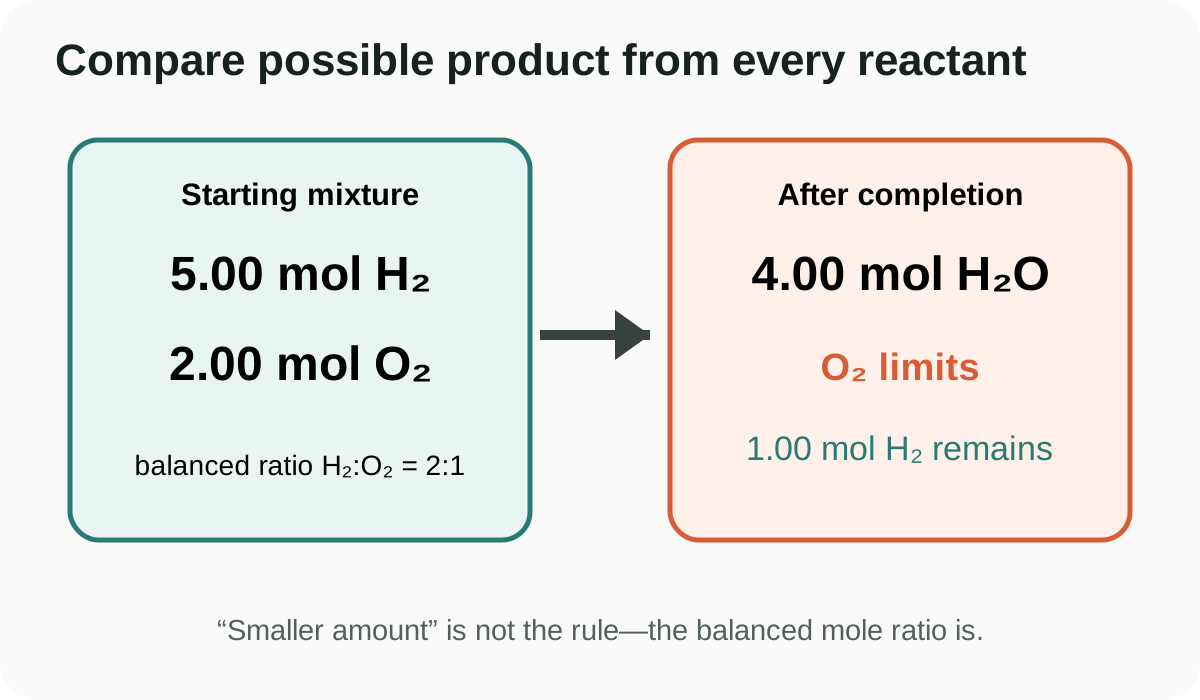
Predict the limiting reactant for 5.00 mol H₂ and 2.00 mol O₂.
Compare product possible from every reactant; starting amount alone does not decide the limit.
Before
Predict the limiting reactant for 5.00 mol H₂ and 2.00 mol O₂.
During
Track atoms, mole ratios, possible product, and leftover reactant.
After
Explain why the smaller starting amount is not automatically limiting.
Lesson reading
live
14 min
Video script
draft
Transcript fallback
available
courses/ap-chemistry/modules/04-chemical-reactions/lessons/01-representing-and-quantifying-reactions/video-transcript.md
Gravimetric Chloride Model Investigation
approved
1 hr 30 min
Mastery check
live
6 questions / 15 min
A reaction equation is not just a sentence. It is a conservation audit. Consider two hydrogen molecules and one oxygen molecule. The balanced equation produces two water molecules. Count atoms: four hydrogen and two oxygen before, and the same after. Now start with five moles of hydrogen and two moles of oxygen. Five is larger, but that does not decide the limiting reactant. Two moles of oxygen can make only four moles of water and consume four moles of hydrogen, leaving one mole. Oxygen limits the product. Quick check: does the reactant with the smaller starting amount always limit? No. Convert to moles and compare using the balanced ratio. Build the full evidence-to-quantity chain free at EduQuest AI.
Reading lab
Connect the lesson's words, diagrams, graphs, evidence, and equations.
How can observations and measurements justify a model of chemical change while conserving atoms, charge, and mass?
A temperature change, gas formation, precipitate, color change, or conductivity change can support a reaction claim, but no single observation automatically proves a specific equation. A defensible explanation links three levels:
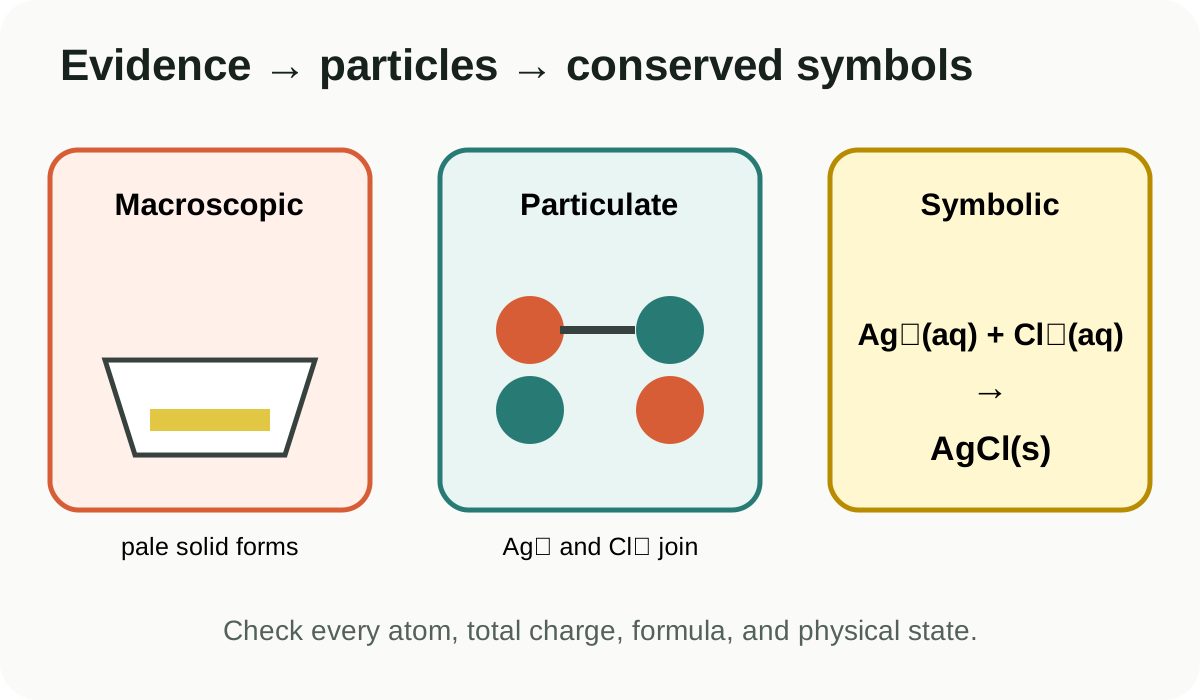
For precipitation of silver chloride:
The complete ionic equation shows soluble strong electrolytes as ions. Cancel unchanged spectator ions to obtain
The net charge is on each side, and Ag and Cl atom counts are conserved. Spectator ions still exist in solution; cancellation means they do not undergo the modeled change.
For
the coefficients mean two moles of react per one mole of . They do not mean equal masses. Convert measurements to moles before applying a mole ratio.
Suppose and react. Compare possible water:
is limiting because it produces less product. It consumes , leaving . The limiting reactant is not necessarily the reactant with the smaller starting mass or mole amount.
Percent yield compares isolated actual yield with calculated theoretical yield:
A yield above signals wet/impure product, measurement error, or an incorrect model—not extra atoms created.
At equivalence in an acid–base titration, reacting amounts match the balanced-equation ratio. Equivalence is a stoichiometric condition; the indicator endpoint is an experimental signal chosen to approximate it.
For a monoprotic acid titrated with ,
only when the balanced ratio is . Volumes must be converted consistently, and delivered buret volume is final minus initial reading.
Gravimetric analysis converts a dried precipitate mass to moles, then uses stoichiometry to infer analyte amount. Complete precipitation, selective reaction, quantitative transfer, washing, and drying to constant mass are model assumptions.
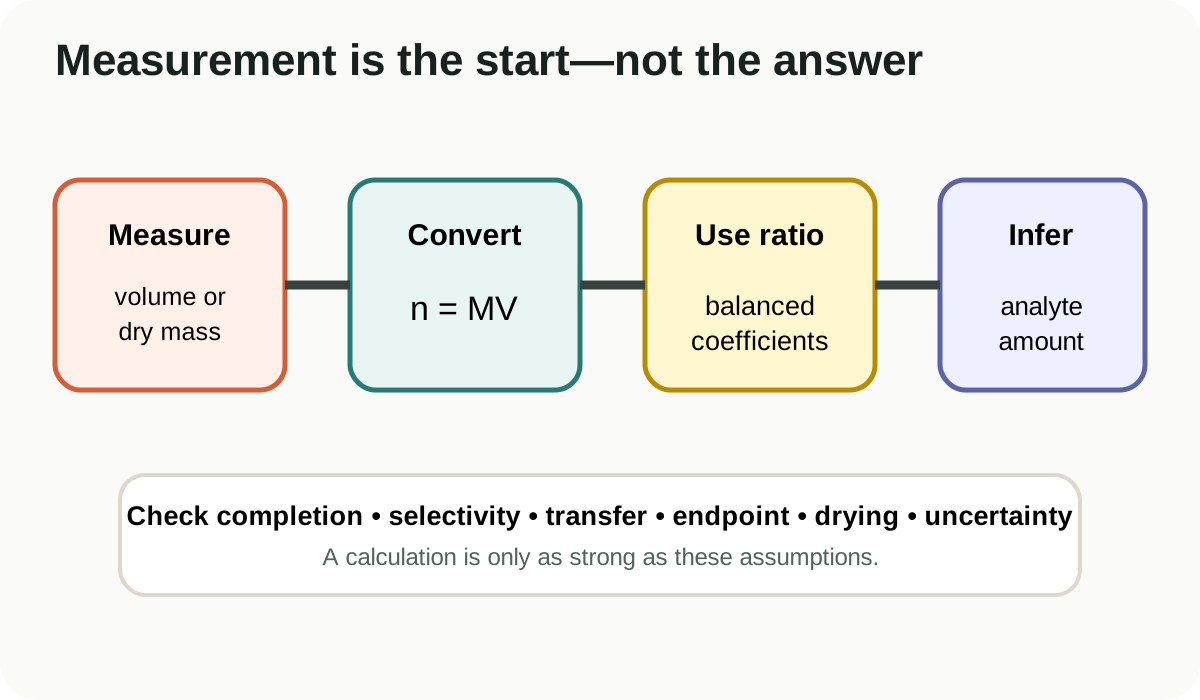
Determine chloride amount from precipitate evidence and evaluate how incomplete drying or transfer loss changes the result.
Perform only under qualified instructor supervision and an approved local risk assessment. Wear splash goggles, apron, and appropriate gloves. Use microscale quantities of instructor-approved chloride and precipitating solutions. Avoid skin/eye contact and ingestion; silver-containing solutions can stain and are environmentally hazardous. For exposure, rinse with water and use the eyewash for at least 15 minutes while notifying the instructor. Follow the site's spill and emergency plan. A supplied-data alternative supports access but does not replace required supervised AP laboratory work.
A dried precipitate mass supports a stoichiometric estimate of chloride amount. Wet product biases the result high; incomplete precipitation or transfer loss biases it low.
Design a blank and spike-recovery check that tests contamination and quantitative recovery.
Collect all silver-containing filtrate, washings, precipitate, filters, and contaminated disposables in labeled hazardous-waste containers; never drain-dispose unless the institution explicitly authorizes it. Offer premeasured containers, seated work, tactile/large-print instructions, or instructor-supplied mass datasets and images while retaining prediction, calculation, and uncertainty analysis.