Lesson reading
live
14 min
Start with the lesson question, connect the representations, and test the model with evidence.
Inspect the opening phenomenon
Predict what changes, then name the evidence.
Apply in the lab
Name the evidence before reading the answer.
Read only what helps
Then use the lab and recall check.
More when needed
Transcript and resources stay available below.
Course progress
Bonding, Geometry, and Property Models
Decision challenge
Use the opening example to make a prediction, identify evidence, and explain which model supports it.
Predict whether the two carbon-oxygen bond dipoles in linear carbon dioxide cancel.
Predict whether bond-dipole vectors cancel after moving from Lewis structure to molecular geometry.
Before
Predict whether the two carbon-oxygen bond dipoles in linear carbon dioxide cancel.
During
Track the change from Lewis structure to 3D geometry before deciding molecular polarity.
After
Explain why water is polar but carbon dioxide is not, using vector addition.
Lesson reading
live
14 min
Video script
draft
Transcript fallback
available
courses/ap-chemistry/modules/02-compound-structure-and-properties/lessons/01-bonding-geometry-and-property-models/video-transcript.md
Molecular Shape and Polarity Model Test
draft
1 hr 20 min
Mastery check
live
6 questions / 15 min
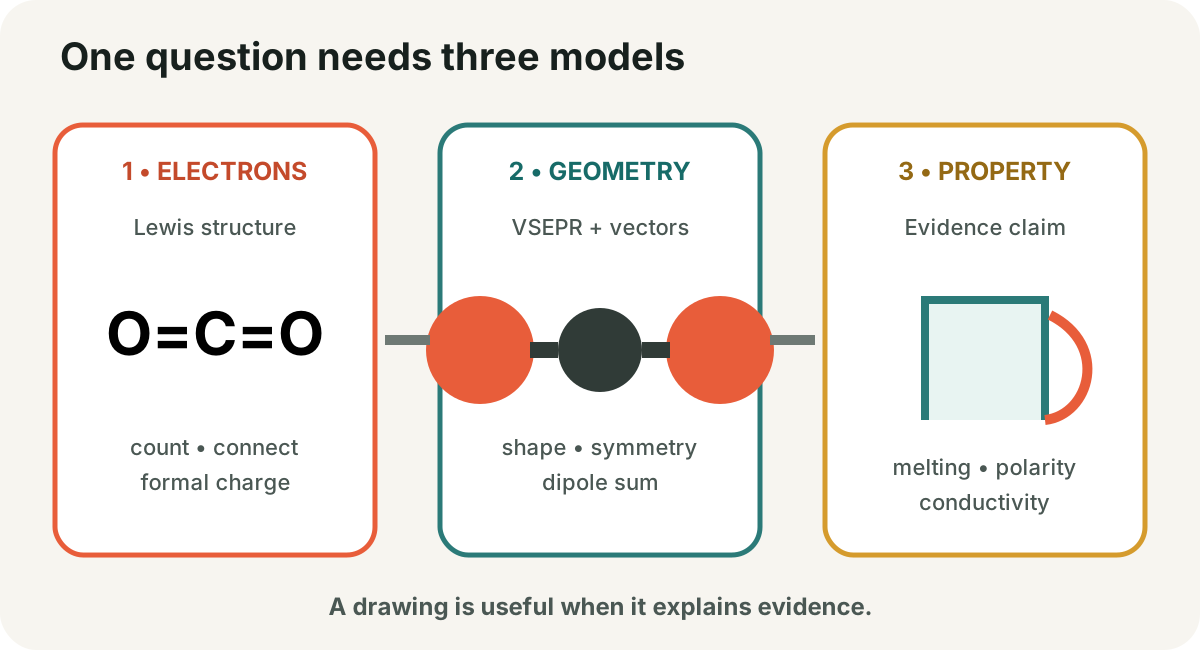
Carbon dioxide has two polar bonds. So why is the molecule nonpolar? Start with the Lewis structure, then use electron domains to reveal a linear molecule. Each carbon–oxygen bond has a dipole, but the two equal vectors point in opposite directions. Their sum is zero. Now compare water. Its oxygen–hydrogen bonds are polar, and its two lone pairs create a bent molecular geometry. Those dipoles do not cancel, so water is polar. Bond polarity does not automatically determine molecular polarity. Quick check: would a perfectly symmetric tetrahedral molecule with four identical outer atoms have a net dipole? No. Geometry decides whether bond dipoles cancel. Learn the full model chain at EduQuest AI.
Reading lab
Connect the lesson's words, diagrams, graphs, evidence, and equations.
How can a two-dimensional electron diagram predict a three-dimensional shape and a macroscopic property?
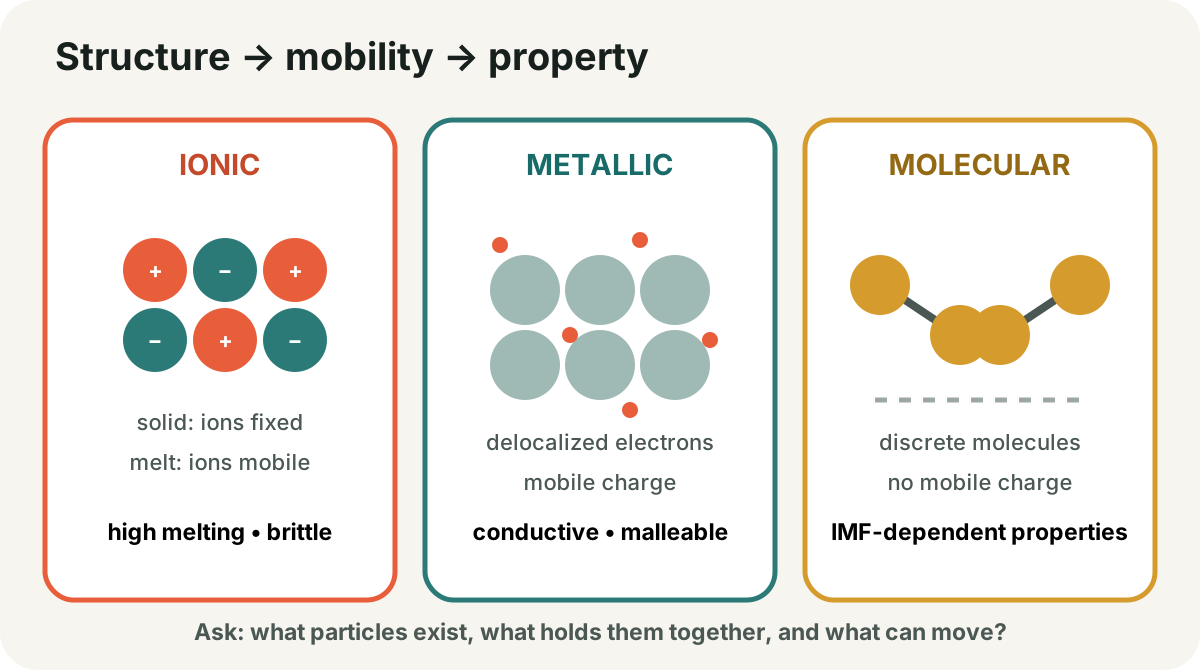
A Lewis structure tracks valence electrons and connectivity. VSEPR predicts geometry from electron-domain repulsions. A structure-and-interaction model explains properties such as conductivity, melting behavior, and brittleness. No single drawing is the molecule.
For an atom in a Lewis structure,
where is valence electrons in the isolated atom, is nonbonding electrons, and is bonding electrons.
Formal charges must sum to the species charge. They are bookkeeping values, not measured partial charges.
When valid structures differ only in electron placement, they are resonance contributors. The actual electron distribution is not rapidly switching drawings; it is represented by a resonance hybrid. Equivalent bonds often have equal intermediate bond orders and lengths.
VSEPR treats each single, double, or triple bond as one electron domain; each lone pair is also one domain. Electron-domain geometry counts all domains, while molecular geometry names only atom positions.
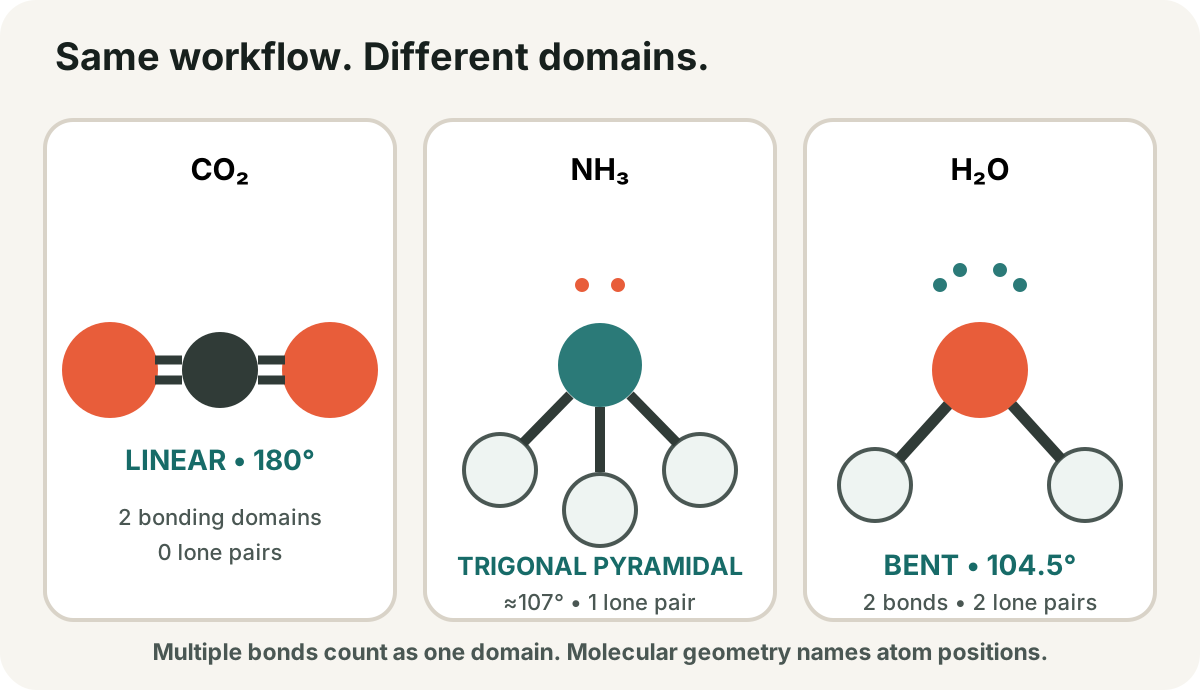
Lone-pair repulsions generally compress adjacent bond angles relative to the ideal tetrahedral angle.
Bond dipoles depend on electronegativity differences. Molecular polarity depends on the vector sum of all bond dipoles and the geometry. Carbon dioxide contains polar bonds but is nonpolar overall because equal opposing dipoles cancel. Water is polar because its bent geometry prevents cancellation.
Both molecules contain polar bonds. is linear, so its two bond-dipole vectors cancel. is bent, so its bond dipoles produce a nonzero molecular dipole. This geometric difference helps explain why water has stronger orientation-dependent intermolecular attractions than carbon dioxide under comparable conditions.
“A double bond counts as two VSEPR domains.” Multiple bonds count as one domain around the central atom.
“A polar bond makes a polar molecule.” Geometry can make bond dipoles cancel.
“Ionic compounds contain separate molecules.” An ionic solid is modeled as an extended lattice; a formula unit gives the lowest whole-number ion ratio.
Strong chemical reasoning moves through a model chain: electrons determine bonding, electron domains constrain geometry, geometry shapes polarity, and particle structure plus interactions explain properties.
How well do Lewis structures and VSEPR predict molecular geometry and net polarity for a set of unknown species?
This is a supervised model-and-data investigation with no chemical reagents. Use blunt model connectors, keep small parts away from mouths and eyes, and follow classroom allergy and accessibility procedures. Collect dropped pieces promptly. No chemical waste is produced; sort reusable pieces for storage. A browser-based molecular viewer or tactile raised-line kit is an accessible alternative.
Learners produce an evidence table connecting electron count, Lewis structure, domain count, geometry, dipole vectors, and measured data. Symmetric molecules can have polar bonds but zero net dipole; lone pairs often reduce bond angles.
Predict and defend the geometry, polarity, and one physical-property implication for a new species with four electron domains and two lone pairs.