Lesson reading
live
55 min
Start with the lesson question, connect the representations, and test the model with evidence.
Inspect the opening phenomenon
Predict what changes, then name the evidence.
Apply in the lab
Name the evidence before reading the answer.
Read only what helps
Then use the lab and recall check.
More when needed
Transcript and resources stay available below.
Course progress
Forward and Inverse Kinematics
Decision challenge
Use the opening example to make a prediction, identify evidence, and explain which model supports it.
Predict whether one hand target always implies one joint configuration.
Before
Predict whether one hand target always implies one joint configuration.
During
Track inputs, outputs, and solution counts for FK and IK.
After
Name three checks required after an IK solution.
Lesson reading
live
55 min
Video script
draft
Transcript fallback
available
courses/ai-robotics/modules/03-motion-frames-and-kinematics/lessons/03-forward-and-inverse-kinematics/video-transcript.md
Two-Link Arm Kinematics Lab
draft
30 min
Mastery check
live
6 questions / 10 min
# Transcript Can one target point have two correct robot-arm solutions? Yes. Forward kinematics starts with joint angles and computes one end-effector pose. For two equal links, angle one zero degrees and angle two ninety degrees places the hand at one, one. Inverse kinematics asks the opposite question: which joint angles reach a desired pose? The answer can be elbow-up, elbow-down, one boundary solution, or no solution when the target is outside the workspace. Even a valid solution still needs joint-limit, collision, and continuity checks. Remember: inverse kinematics returns a pose candidate, not a safe path. Explore the full lesson on EduQuest.
Reading lab
Connect the lesson's words, diagrams, graphs, evidence, and equations.
Opening challenge: If a robot hand must reach one point, is there always exactly one set of joint angles that works?
Forward kinematics (FK) starts with joint configuration and computes an end-effector pose: . Inverse kinematics (IK) starts with a desired end-effector pose and searches for a configuration that satisfies it.
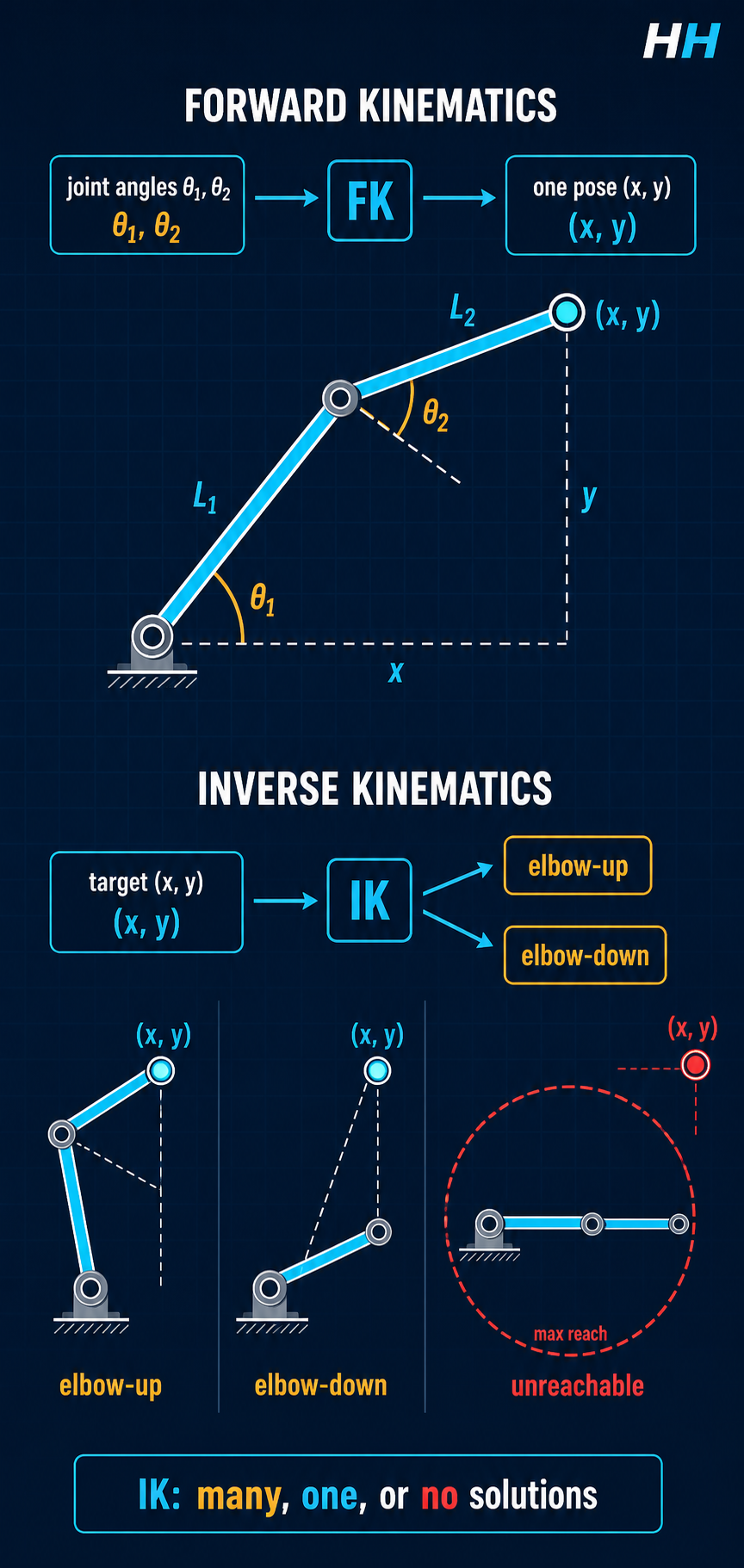
For a planar two-link arm with link lengths and angles :
With , , and , FK gives .
The target can have an elbow-up and elbow-down solution. Some targets have one solution at a workspace boundary. Targets farther than are unreachable. A numerical IK solver can also fail even when a geometric solution exists because of its seed, timeout, or local minimum.
A pose solution is not automatically a safe motion. Useful IK must consider:
Joint space describes configurations such as . Task space describes an outcome such as hand pose . FK maps joint space to task space. IK searches from a task-space request back to joint space. Redundant arms may have infinitely many configurations that satisfy a lower-dimensional task, so an objective such as staying near a comfortable posture selects among them.
Sources are linked and paraphrased. The visual is an original HH educational asset.
Compute FK and compare multiple IK candidates while checking reachability and constraints.
Use degrees consistently or convert to radians before calculator functions. No hardware is required.
FK for gives . The target can admit multiple configurations. is unreachable because its distance from the base exceeds .
Score each valid solution by distance from the current joint configuration and obstacle clearance, then justify the selected posture.
Use a coordinate table instead of drawing. This simulation-first lab requires no moving hardware.