Lesson reading
live
1 hr
Start with the lesson question, connect the representations, and test the model with evidence.
Inspect the opening phenomenon
Predict what changes, then name the evidence.
Apply in the lab
Name the evidence before reading the answer.
Read only what helps
Then use the lab and recall check.
More when needed
Transcript and resources stay available below.
Course progress
Detection, Segmentation, Pose, and Tracking
Decision challenge
Use the opening example to make a prediction, identify evidence, and explain which model supports it.
Choose the minimum sufficient perception output and verify geometry and time.
Choose the minimum sufficient perception output and verify geometry and time.
Lesson reading
live
1 hr
Video script
draft
Transcript fallback
available
courses/ai-robotics/modules/06-robot-perception-and-computer-vision/lessons/02-detection-segmentation-pose-and-tracking/video-transcript.md
Choose and Audit a Perception Output
draft
30 min
Mastery check
live
6 questions / 10 min
# Transcript A robot sees a cup. What should vision return? Classification answers what, but not where. Detection adds a bounding box: rough location, not an exact boundary. Segmentation labels pixels, useful for object shape or drivable floor. Pose estimates rotation and translation in named frames when geometry and correspondences support it. Tracking associates a target across time, but IDs can switch after occlusion. For a grasp, a class score alone is not enough. Verify depth, pose error, timestamp age, and track continuity. Choose the minimum sufficient output for the action, then define what evidence must stop it. Which output labels every pixel, and which preserves identity over time? Continue the lab on EduQuest.
Reading lab
Connect the lesson's words, diagrams, graphs, evidence, and equations.
A warehouse robot sees a cup. “Cup” alone may be enough to count inventory, but not to grasp it. Robot perception must return the type of evidence the next component actually needs.
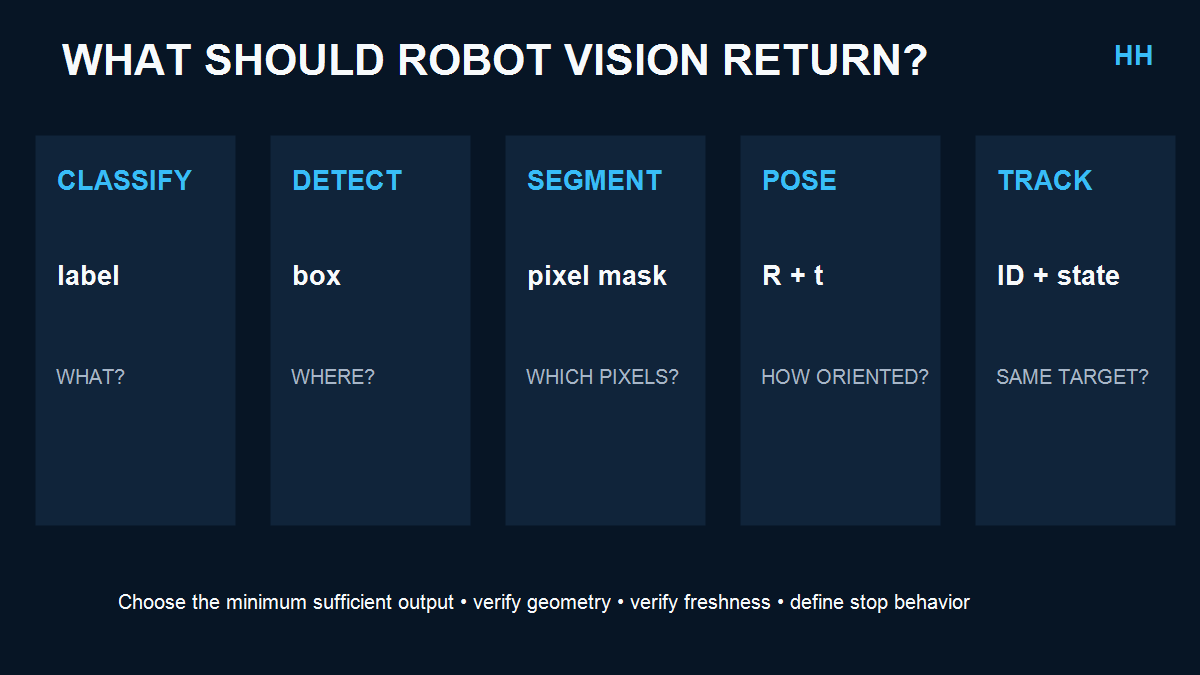
| Task | Output | Answers | Does not guarantee |
|---|---|---|---|
| Classification | class scores | What is prominent? | location |
| Detection | class + bounding box | What and roughly where? | exact boundary or depth |
| Segmentation | pixel labels/masks | Which pixels belong where? | 3D orientation |
| Pose estimation | rotation + translation or keypoints | How is it positioned? | persistent identity |
| Tracking | identity + state over time | Is this the same target now? | correct detection forever |
These are contracts, not a ladder where the “largest” output is always best. Choose the smallest output that safely supports the action.
Goal: pick the blue cup, not the blue tray.
cup: 0.83, but gives no location.(220, 140, 180, 240) for a cup.solvePnP can estimate rotation and translation when the object geometry is known.Before grasping, verify depth, pose reprojection error, fresh timestamps, and whether the track survived occlusion. A confidence score is model output—not a probability that the action is safe.
Retrieval pause: Which output do you need to paint only drivable-floor pixels? Segmentation.
A detector can produce independent boxes in each frame. A tracker predicts a target state, associates new measurements, updates the state, and records missed observations. Identity switches can occur when targets cross or disappear. Use track age, missed-frame count, motion consistency, and re-detection evidence—not only the displayed ID.
State the downstream question first. Then choose the output, define measurable acceptance checks, test changing light/viewpoint/occlusion, and specify a safe response to stale or conflicting evidence.
Classification, detection, segmentation, pose, and tracking answer different questions. Reliable robotics preserves those distinctions and tests spatial, geometric, and temporal evidence before acting.
Select the minimum sufficient perception output and identify evidence that must block action.
lab-worksheet.csvCounting can use classification or detection; grasping normally needs localization plus depth/pose; drivable-area reasoning needs segmentation; following a person needs tracking with re-identification and stale-data rules.
Add an occlusion scenario and define the maximum number of missed frames before the robot pauses.
All scenarios are textual. Describe masks as included/excluded pixel sets and pose as named-frame rotation plus translation.