Lesson reading
live
40 min
Start with the lesson question, connect the representations, and test the model with evidence.
Inspect the opening phenomenon
Predict what changes, then name the evidence.
Apply in the lab
Name the evidence before reading the answer.
Read only what helps
Then use the lab and recall check.
More when needed
Transcript and resources stay available below.
Course progress
Autonomy, Goals, and Human Oversight
Decision challenge
Use the opening example to make a prediction, identify evidence, and explain which model supports it.
Predict which decisions belong to the human and which may be delegated to the robot.
Who decides what when a robot is autonomous? A 48-second Humanoid Hub tutorial on delegated decision authority and human oversight.
Before
Predict which decisions belong to the human and which may be delegated to the robot.
During
Record the goal, constraints, robot choices, and four oversight actions.
After
Explain why nominal human involvement does not guarantee effective oversight.
Lesson reading
live
40 min
Video script
draft
1 min target
Transcript fallback
available
courses/ai-robotics/modules/01-what-makes-a-robot-intelligent/lessons/03-autonomy-goals-and-human-oversight/video-transcript.md
Autonomy Boundary Design Lab
draft
25 min
Mastery check
live
6 questions / 10 min
# Who Decides? Robot Autonomy Explained — Transcript An autonomous robot does not mean humans disappear. It means we must define who decides what. People define the goal and constraints: deliver to Room 205, protect people, avoid restricted areas, and stop when confidence is too low. The robot may perceive, choose among approved paths, and act. That is delegated authority inside a boundary—not permission to ignore the rules. Real oversight lets people monitor evidence, intervene, stop safely, and handle escalations. A human name on a dashboard is not enough. Ask four questions: What is the goal? What are the constraints? Which choices are delegated? And what happens when evidence fails? Follow HumanoidHub for practical AI robotics lessons.
Reading lab
Connect the lesson's words, diagrams, graphs, evidence, and equations.
A hospital delivery robot receives this instruction: deliver medicine to Room 205. It encounters a blocked corridor. May it choose another hallway? May it enter a staff-only area? May it use an elevator? May it delay delivery to recharge?
The word autonomous does not answer those questions. A useful design names which decisions people retain, which decisions the robot may make, and what happens when evidence becomes uncertain.
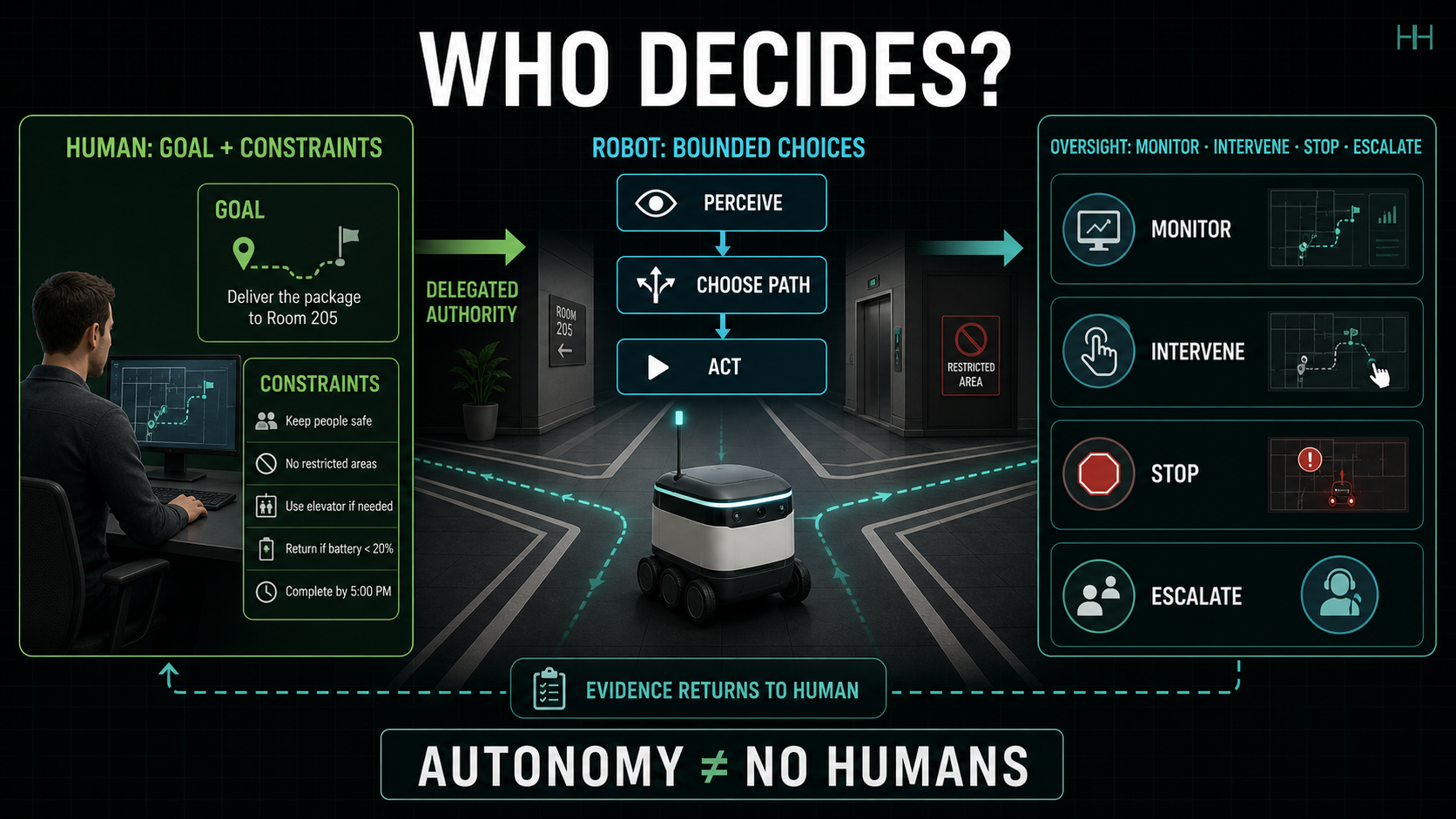
In this course, autonomy is delegated decision authority within defined boundaries. It is not the absence of humans.
Four layers keep the boundary visible:
| Layer | Question | Delivery example |
|---|---|---|
| Goal | What outcome matters? | Deliver the medicine to Room 205 by 5:00 PM. |
| Constraints | What must remain true? | Avoid restricted areas; keep clearance from people; protect the payload. |
| Delegated choices | What may the robot decide? | Choose among approved routes; adjust speed; use the elevator. |
| Oversight | How can people know and respond? | Monitor status; intervene; stop; resolve an escalation. |
A goal describes a desired result. A constraint limits how that result may be achieved. A robot choice selects an allowed action. Oversight makes the delegation observable and reversible.
Avoid assigning one vague autonomy label to an entire robot. The same machine can have different authority for different functions:
NHTSA's driving-automation model illustrates this role-based idea: the important question is which actor performs which part of the driving task and fallback, not whether a vehicle is simply “autonomous.” The exact levels are specific to road vehicles, but the design habit transfers to robotics.
“A human is watching” is not a complete safety design. Effective oversight needs four verbs:
NIST's AI Risk Management Framework emphasizes clear roles, documented risks, measurement, monitoring, and governance across the system lifecycle. For a robot, those practices become concrete controls: logs, alerts, confidence thresholds, permissions, fallback behavior, and named owners.
The delivery robot finds its normal route blocked.
Mission contract
| Robot response | Evaluation |
|---|---|
| Take another approved corridor | Inside the autonomy boundary. |
| Enter a restricted shortcut | Violates a constraint even if it reaches the goal faster. |
| Continue while localization confidence is low | Violates the stopping condition. |
| Wait safely and request a route exception | Uses the designed escalation path. |
Notice that a successful delivery can still be unacceptable if the robot violates a constraint. Outcome alone is not enough; the path and evidence matter.
Oversight must operate at the speed of the risk. A person cannot meaningfully approve every motor command. Fast collision avoidance belongs inside the robot's verified control boundary. A person can supervise slower decisions such as entering a new zone, changing a mission, or accepting a degraded sensor.
For each decision, ask:
If the robot can cause harm faster than an operator can notice and respond, “human in the loop” may be only a slogan.
Without looking back, complete this sentence:
The human defines ______ and ______; the robot makes ______ choices; oversight provides ______, ______, ______, and ______.
Then classify each statement as goal, constraint, delegated choice, or oversight action:
Before calling a robot autonomous, document:
Autonomy is a contract about decisions. People establish goals, constraints, permissions, and accountability. Robots make bounded choices using current evidence. Oversight closes the governance loop through monitoring, intervention, stopping, escalation, and review.
Create and test an autonomy contract for a service robot without requiring hardware.
Paper, a diagram tool, or a spreadsheet. Use the provided autonomy-boundary visual as a reference.
A one-page autonomy contract with goal, constraints, decision allocation, evidence, thresholds, safe state, escalation owner, and event traces.
Your autonomy contract makes every important decision traceable to an owner, evidence source, permission boundary, and fallback. All three injected events should end in an allowed continuation, a verified replan, a safe stop, or a named human escalation rather than an undefined action.
Add a second operating mode with degraded sensing. Reduce the robot's delegated authority, revise its thresholds, and explain exactly which decisions transfer back to the human operator.
The lab is fully text-based. Describe any diagram in a table with columns for decision, owner, evidence, limit, and fallback.