Lesson reading
live
55 min
Start with the lesson question, connect the representations, and test the model with evidence.
Inspect the opening phenomenon
Predict what changes, then name the evidence.
Apply in the lab
Name the evidence before reading the answer.
Read only what helps
Then use the lab and recall check.
More when needed
Transcript and resources stay available below.
Course progress
Perception Quality and Sensor Fusion
Decision challenge
Use the opening example to make a prediction, identify evidence, and explain which model supports it.
Agreement is insufficient without comparable, valid, uncertainty-aware evidence.
Agreement is insufficient without comparable, valid, uncertainty-aware evidence.
Lesson reading
live
55 min
Video script
draft
Transcript fallback
available
courses/ai-robotics/modules/06-robot-perception-and-computer-vision/lessons/03-perception-quality-and-sensor-fusion/video-transcript.md
Audit and Gate a Fusion Pipeline
draft
30 min
Mastery check
live
6 questions / 10 min
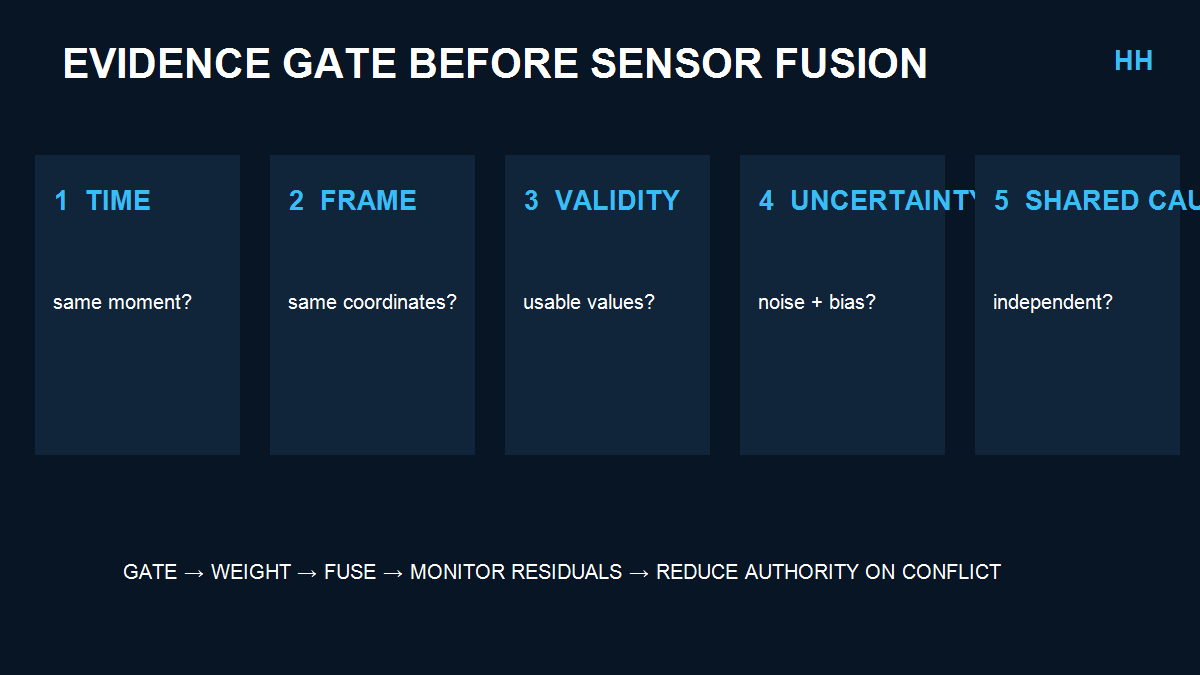
# Transcript Two sensors agree. Can the robot trust them? Not until their evidence passes a gate. First, time: do acquisition timestamps describe the same physical moment? Second, frame: can both measurements be transformed into one named frame? Third, validity: are values in range and free of invalid codes? Fourth, uncertainty: how noisy or biased is each source? Fifth, independence: can both fail for the same reason? Quality metrics also answer different questions. Precision measures false-alarm control; recall measures missed-target control. Slice both by real operating conditions because averages hide distribution shift. Only after the gate should the robot weight and combine evidence, monitor disagreement, and fail conservatively. Which check must happen before weighted averaging? Continue the lab on EduQuest.
Reading lab
Connect the lesson's words, diagrams, graphs, evidence, and equations.
Not automatically. Two sensors can agree because both are stale, misaligned, biased, or observing different moments. Fusion begins by deciding whether evidence is comparable.
For a target detector:
TP / (TP + FP): when the model reports a target, how often is it correct?TP / (TP + FN): how many real targets did it find?A threshold can trade recall for precision. The right balance depends on the action and the cost of each error.
Across 50 labeled scenes, a detector produces TP=32, FP=8, and FN=10.
precision = 32/40 = 0.80 and recall = 32/42 ≈ 0.76.
That is not a universal quality score. Break results down by conditions: bright/dim light, near/far range, clear/occluded targets, and familiar/unfamiliar backgrounds. NIST emphasizes realistic test sets and ongoing deployed monitoring because performance can fail outside development conditions.
Retrieval pause: If missed people are more harmful than extra alerts, which metric deserves special attention? Recall, while still managing false alarms.
Training examples do not define the whole world. New lighting, camera placement, weather, clothing, clutter, or sensor aging can change the input distribution. Monitor condition slices, not only an average. When the system operates beyond tested limits, reduce authority or request human review.
Before combining camera and lidar evidence, run an evidence gate:
ROS ApproximateTimeSynchronizer matches messages using header timestamps and a configured tolerance. Arrival time is not a safe substitute when delays are unpredictable.
For independent scalar measurements z1 and z2 with variances v1 and v2, a teaching approximation is:
z_fused = (z1/v1 + z2/v2) / (1/v1 + 1/v2).
Lower variance receives more weight, but a precise biased sensor can still dominate incorrectly. Gate first, fuse second, then monitor residual disagreement.
Perception quality is conditional evidence. Measure task-relevant errors, test deployment conditions, preserve time and frame, gate invalid inputs, fuse uncertainty-aware measurements, and fail conservatively when evidence conflicts.
Calculate condition-specific quality and decide which sensor pairs may be fused.
lab-worksheet.csv0.10 s, frames can be transformed consistently, and both readings are valid.Dim-light recall is worse than bright-light recall. Some pairs must be rejected despite plausible values because they are stale or framed incompatibly.
Apply the inverse-variance formula to two accepted scalar measurements and explain its independence assumption.
All evidence is numeric and textual; color is never required to interpret acceptance.