Lesson reading
live
45 min
Start with the lesson question, connect the representations, and test the model with evidence.
Inspect the opening phenomenon
Predict what changes, then name the evidence.
Apply in the lab
Name the evidence before reading the answer.
Read only what helps
Then use the lab and recall check.
More when needed
Transcript and resources stay available below.
Course progress
Sensors and Measurement Uncertainty
Decision challenge
Use the opening example to make a prediction, identify evidence, and explain which model supports it.
Predict whether a tight cluster of readings can still be wrong.
A precise reading can still be biased or stale.
Before
Predict whether a tight cluster of readings can still be wrong.
During
Separate noise, bias, resolution, and latency.
After
Name the four parts of decision-ready sensor evidence.
Lesson reading
live
45 min
Video script
draft
Transcript fallback
available
courses/ai-robotics/modules/02-robot-bodies-sensors-actuators-compute/lessons/02-sensors-and-uncertainty/video-transcript.md
Sensor Evidence Investigation
draft
30 min
Mastery check
live
6 questions / 10 min
# Transcript A robot says the box is exactly one metre away. Should you believe it? A reading is evidence, not ground truth. Noise spreads repeated readings. Bias shifts the whole cluster. Resolution limits meaningful digits. Latency makes a precise reading describe the past. Calibration relates the sensor to a reference under conditions—it does not guarantee every future measurement. A robot needs an estimate, uncertainty, timestamp, and safe fallback. Which is more dangerous: noisy evidence, or precise evidence with hidden bias? Learn to test both in the free EduQuest AI Robotics course. Follow Humanoid Hub.
Reading lab
Connect the lesson's words, diagrams, graphs, evidence, and equations.
Opening challenge: A rover reports that a box is 1.00 m away. What does that number actually prove?
Almost nothing by itself. We need to know what quantity was measured, how the sensor was calibrated, when the reading was captured, the operating conditions, and how much variation or bias could be present.
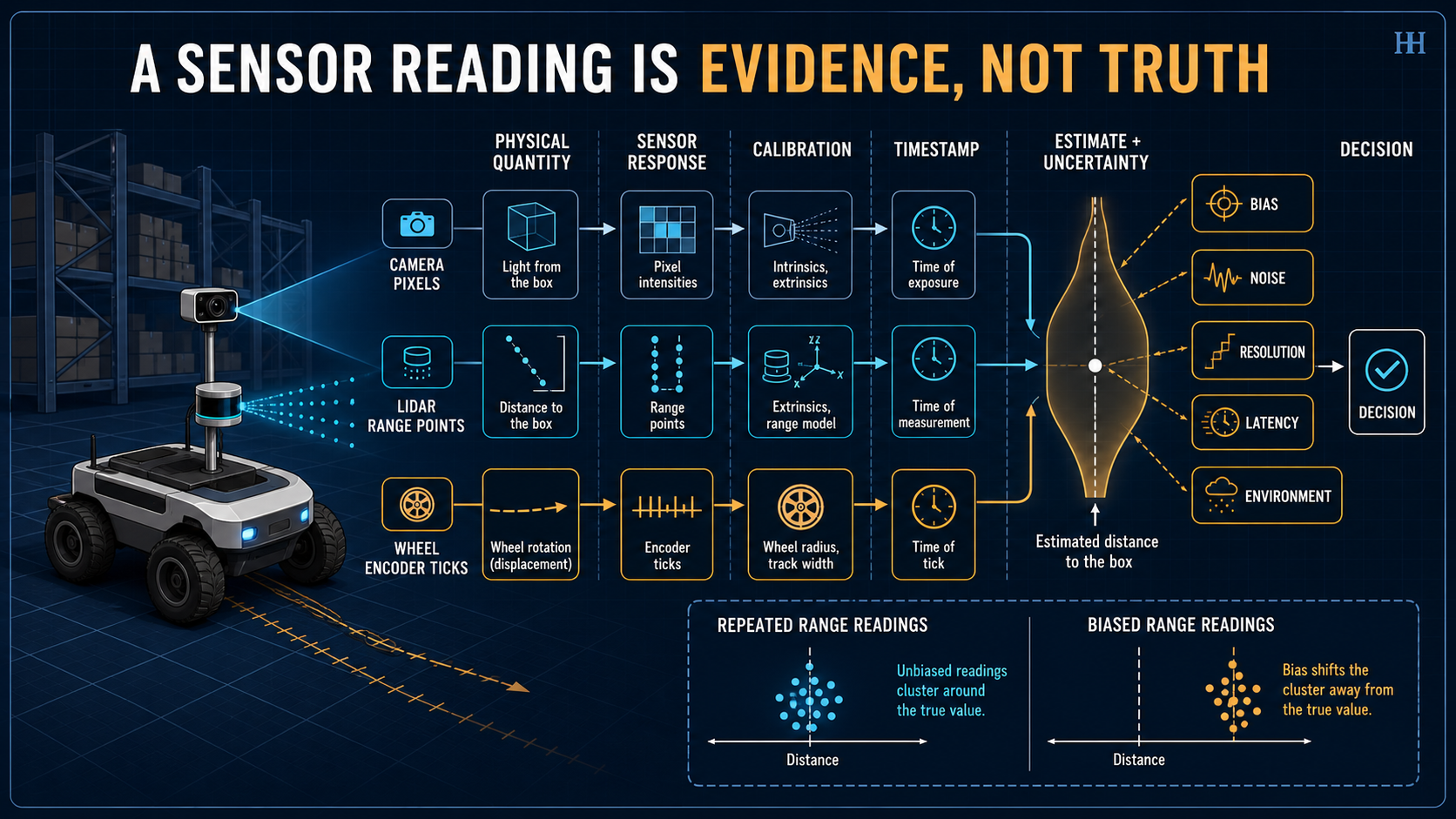
NIST describes measurement as a process that produces a value reasonably attributable to a quantity—the measurand. Measurement uncertainty characterizes the dispersion of values that could reasonably be attributed to it. For a robot, useful evidence therefore has at least four parts:
estimate + uncertainty + timestamp + operating conditions
The estimate might be distance, brightness, acceleration, temperature, or wheel rotation. The remaining parts tell the robot whether that estimate is fit for the current decision.
| Effect | What it means | Evidence that reveals it | Possible response |
|---|---|---|---|
| Random variation | Repeated readings spread | repeated trials, standard deviation, histogram | filter cautiously; preserve variation estimate |
| Bias | Readings are systematically offset | comparison with a reference | calibrate or correct; investigate cause |
| Resolution | Sensor reports discrete steps | smallest observable increment | avoid claiming finer precision |
| Drift | Response changes with time or temperature | repeated reference checks | recalibrate; monitor temperature and age |
| Latency/staleness | Reading describes an earlier state | capture timestamp and arrival time | reject stale evidence; slow or stop |
| Environmental interference | Lighting, reflectivity, vibration, weather, or geometry changes response | controlled condition tests | change modality, viewpoint, or operating envelope |
Accuracy concerns closeness to an accepted reference. Precision concerns the spread of repeated readings. A tight cluster can still be biased. A broad cluster may average near the reference yet remain unreliable for one-shot decisions.
A range sensor returns five readings in metres:
0.96, 1.02, 1.00, 0.98, 1.04
Their mean is 1.00 m and the range is 0.08 m. That describes repeatability only under this test. It does not include calibration uncertainty, surface reflectivity, mounting error, or timestamp delay.
Now suppose comparison with a reference repeatedly shows the sensor reads 0.05 m too high. The cluster is precise but biased. A correction may improve the estimate, but the uncertainty of the reference and correction must still be considered.
If the rover moves at 1 m/s and the complete sensing-to-actuation chain is 0.20 s old, the robot travels about 0.20 m while using that evidence. This is why a numerically precise but stale reading can be unsafe.
Calibration establishes a relationship between indications and reference values under specified conditions. NIST also warns that later use adds uncertainty from the instrument, method, operator, and environment. Calibration supports traceability; it does not guarantee future performance in every deployment.
ROS 2's sensor-data QoS profile favors timely recent samples over guaranteed delivery of every sample. That trade-off makes sense only when the consumer checks timestamps and defines behavior for missing, delayed, or incompatible data. “Delivered” is not the same as “current.”
Without looking back:
“More decimal places mean more certainty.” Display formatting cannot create sensor resolution or reduce uncertainty.
“Averaging removes every error.” Averaging can reduce random variation; it does not automatically remove bias or drift.
“Calibration makes the sensor correct.” Calibration relates indications to references under conditions and with uncertainty.
“Sensor fusion creates truth.” Combining correlated, biased, or stale inputs can produce confident-looking error. Fusion must model provenance and dependence.
For each measurement stream, record the quantity and units, coordinate frame, timestamp source, expected rate, valid range, resolution, calibration identity, uncertainty model, environmental limits, stale-data threshold, and safe fallback. Test the integrated evidence chain rather than approving a sensor in isolation.
A robot never receives ground truth directly. It receives indications shaped by physics, calibration, sampling, transport, and the environment. Good robotics makes uncertainty visible, tests both repeatability and bias, preserves timestamps, and changes behavior when evidence is no longer decision-ready.
Separate random variation, bias, resolution, and staleness using a simulation-first measurement log.
Paper or a spreadsheet; no hardware or paid software is required.
98, 101, 99, 102, 100, 99, 101, 100 cm for a reference distance of 100 cm.103, 104, 105, 104, 103, 105, 104, 104 cm. Compare spread and offset.Submit calculations, two plots, bias/precision classifications, a resolution comparison, stale-data markings, an uncertainty budget, and explicit safe responses. A strong result does not call either dataset “truth.”
Design a two-sensor check without assuming the sensors fail independently. Explain how shared lighting, vibration, power, time, or calibration could correlate their errors.
Use a table instead of a visual plot if needed. All required evidence can be expressed as text. Do not alter safety sensors on real machinery.