Lesson reading
live
5 min
Start with the lesson question, connect the representations, and test the model with evidence.
Inspect the opening phenomenon
Predict what changes, then name the evidence.
Apply in the lab
Name the evidence before reading the answer.
Read only what helps
Then use the lab and recall check.
More when needed
Transcript and resources stay available below.
Course progress
Rolling Without Slipping and Coupled Motion
Decision challenge
Use the opening example to make a prediction, identify evidence, and explain which model supports it.
Predict the top, center, and contact-point speeds for a wheel rolling without slipping.
Combine translation and rotation, apply the no-slip constraint, and connect inertia to rolling acceleration.
Before
Predict the top, center, and contact-point speeds for a wheel rolling without slipping.
During
Pause at v equals R omega and identify the condition required for that constraint.
After
Explain why a solid cylinder reaches the bottom before a hoop released from the same height.
Lesson reading
live
5 min
Video script
draft
Transcript fallback
available
courses/ap-physics-1/modules/06-energy-and-momentum-of-rotating-systems/lessons/02-rolling-without-slipping-and-coupled-motion/video-transcript.md
Testing the No-Slip Rolling Model
draft
1 hr 15 min
Mastery check
live
7 questions / 18 min
--- lesson_slug: 02-rolling-without-slipping-and-coupled-motion duration_seconds: 55 --- # Transcript A rolling wheel moves forward—but the point touching the ground is instantaneously stopped. The center translates at v. Rotation adds v forward at the top and v backward at the bottom. So the top moves at two v, the center at v, and contact at zero. That cancellation is rolling without slipping: v equals R omega. If the wheel slides, this equation is not yet valid. Down the same ramp, a solid cylinder beats a hoop. Its mass lies closer to the axis, so less energy is locked into rotation. Pause: if radius doubles at the same angular speed, what happens to the center speed? It doubles. Learn the full rolling model free in AP Physics 1 at EduQuest AI.
Reading lab
Connect the lesson's words, diagrams, graphs, evidence, and equations.
How can one contact condition lock a body's translation and rotation together?
A solid cylinder and a hoop have equal mass and radius and start from rest at the same ramp height. Predict which arrives first and name the evidence your model needs.
For pure rolling on a stationary surface, the wheel's bottom point has zero instantaneous velocity relative to the ground. The center translates at while rotation contributes an equal backward speed at contact:
This is a kinematic constraint, not an extra force.
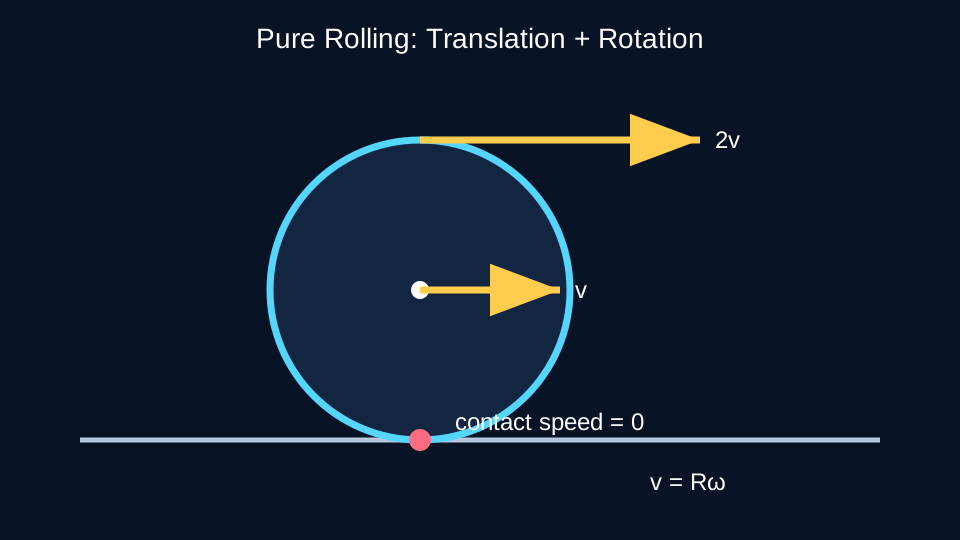
When is constant and rolling remains no-slip,
The top point moves at relative to the ground, the center at , and the contact point at zero. These are instantaneous velocities; the material point at contact still has centripetal acceleration.
A wheel of radius rolls without slipping at . Then
If , then .
For a rigid object,
Writing and using gives
Rolling from rest down through height with negligible losses:
A solid cylinder has and a hoop has , so the cylinder reaches a larger speed from the same height.
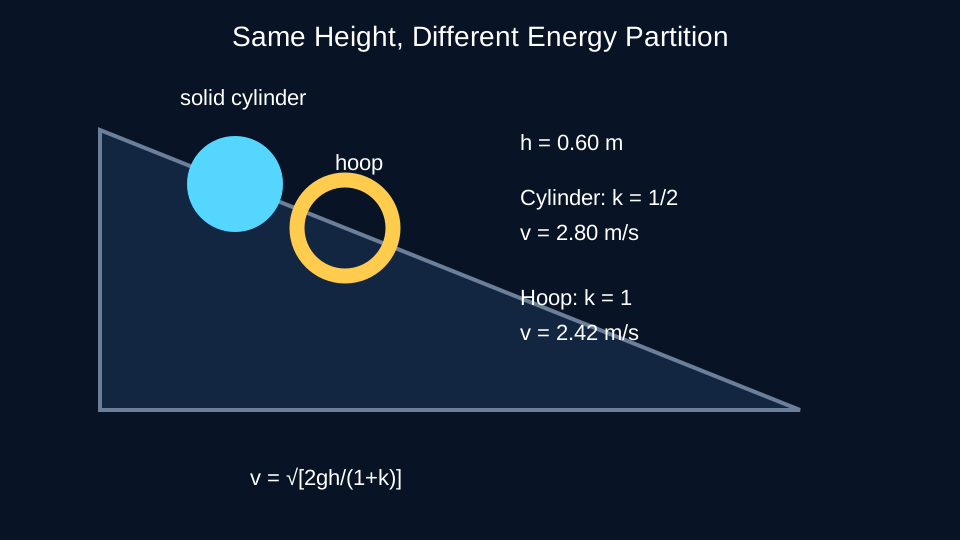
At with :
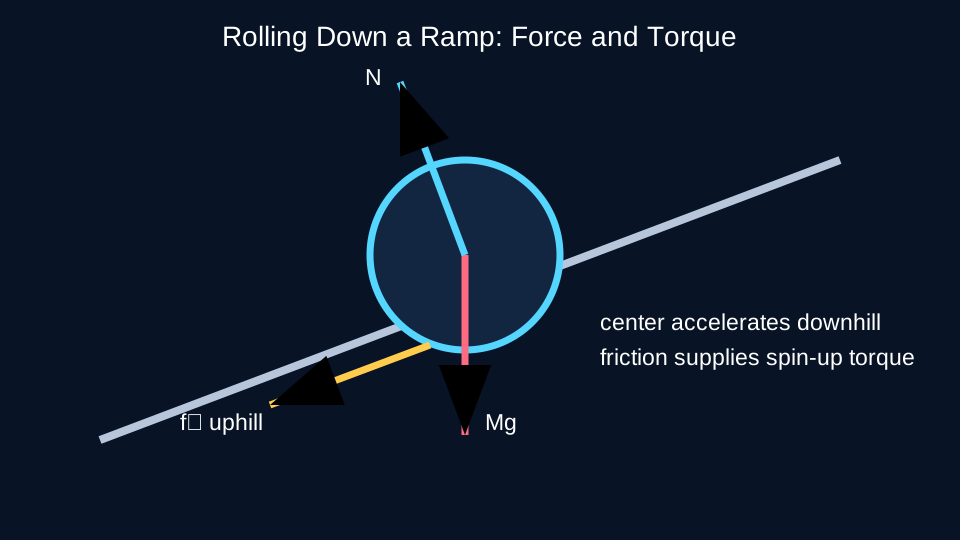
Static friction prevents relative sliding at contact when the needed force does not exceed . On a passive object rolling down a ramp, friction points uphill and supplies the torque that increases . In other driven situations it can point downhill or be zero. Determine its direction from the required no-slip dynamics—not from the center's motion alone.
For an object rolling down angle ,
and . Therefore,
Without calculating, rank the acceleration of a hoop, solid cylinder, and solid sphere of equal radius on the same ramp. Explain using .
A cord that does not slip on a pulley couples linear and angular variables: and . The pulley needs a net torque, so tensions on its two sides generally differ. Treat each body and the pulley as separate systems, then connect their equations using the constraint.
A wheel begins sliding and spinning, then transitions to rolling. State which constraint becomes valid only after slipping stops, and describe how you would test that claim from video data.
For every rolling problem: define the system, decide whether no-slip is justified, draw forces, write translation and rotation equations or an energy model, impose the constraint only when valid, and check units plus limiting cases.
See sources.yaml for the College Board alignment and OpenStax verification references. This lesson and all problems are original and do not imply College Board endorsement.
Test and determine how mass distribution changes acceleration down a ramp.
Work with teacher or responsible-adult supervision. Secure a low-angle ramp, use only low-mass blunt rolling objects, install a soft catch box, and keep hands and feet outside the lane. Do not use glass, sharp, motorized, or high-speed objects. Stop if the ramp shifts or an object bounces unpredictably.
Accessible alternative: use teacher-provided videos with frame numbers, scale, and tactile/high-contrast object descriptions. A student may direct measurements and analysis without handling apparatus.
Simulation alternative: use a teacher-approved rolling simulation and record its idealizations.
For valid no-slip trials, should be near 1 within uncertainty. The object with smaller should accelerate faster.
Report measured quantities with units and uncertainty. Graph against with an equal-value reference line. Compare measured accelerations with . Discuss surface deformation, camera perspective, release impulse, and slipping as limitations.
Increase the ramp angle gradually within the supervisor-approved safe range. Identify when the no-slip model first becomes questionable and defend the criterion with data.