Lesson reading
live
5 min
Start with the lesson question, connect the representations, and test the model with evidence.
Inspect the opening phenomenon
Predict what changes, then name the evidence.
Apply in the lab
Name the evidence before reading the answer.
Read only what helps
Then use the lab and recall check.
More when needed
Transcript and resources stay available below.
Course progress
Center of Mass and Collision Models
Decision challenge
Use the opening example to make a prediction, identify evidence, and explain which model supports it.
Predict whether the center of mass moves when a stationary cart separates into two pieces with negligible external impulse.
Track total momentum and center-of-mass motion, then compare the speeds of unequal-mass pieces.
Before
Predict whether the center of mass moves when a stationary cart separates into two pieces with negligible external impulse.
During
Pause when the center-of-mass velocity equation appears and connect it to total momentum.
After
Explain why the lighter piece moves faster when the pieces have equal-magnitude opposite momenta.
Lesson reading
live
5 min
Video script
draft
Transcript fallback
available
courses/ap-physics-1/modules/04-linear-momentum/lessons/02-center-of-mass-and-collision-models/video-transcript.md
Track Center of Mass Through Collisions
draft
1 hr 25 min
Mastery check
live
7 questions / 15 min
# Accessible transcript: An Explosion That Doesn't Move the System An explosion can send pieces flying while the system stays put. Track the center of mass: the mass-weighted average position of all pieces. Center-of-mass velocity equals total momentum divided by total mass. If the cart starts at rest and external impulse is negligible, total momentum stays zero. The pieces get equal and opposite momenta, so the center of mass remains at rest. Quick check: which piece moves faster, the lighter or heavier one? Pause. The lighter piece, because equal momentum means speed is inversely proportional to mass. Learn momentum free at EduQuest AI. ## Visual description A stationary cart separates into unequal pieces moving opposite directions. Equal-length momentum arrows point away while a center-of-mass marker stays fixed. The lighter piece's velocity arrow is longer.
Reading lab
Connect the lesson's words, diagrams, graphs, evidence, and equations.
How can a complicated many-object interaction be described by one system point and a small set of conservation tests?
Two unequal pieces push apart from a cart initially at rest on a nearly frictionless track. Sketch each piece's motion and predict the center-of-mass motion. Which piece moves faster?
Internal forces can send pieces in opposite directions while the system center of mass remains at rest. Only net external force changes center-of-mass momentum.
For particles,
In one dimension,
The center lies closer to the larger mass and can lie in empty space.
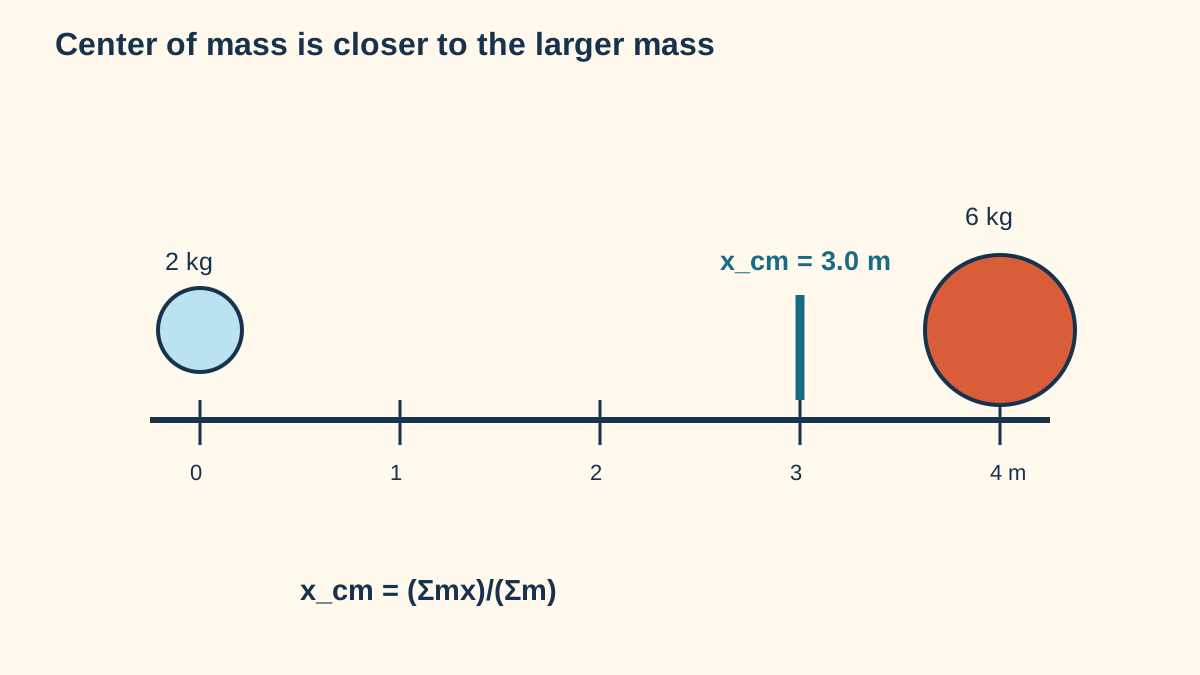
A mass is at and a mass at :
Therefore
and
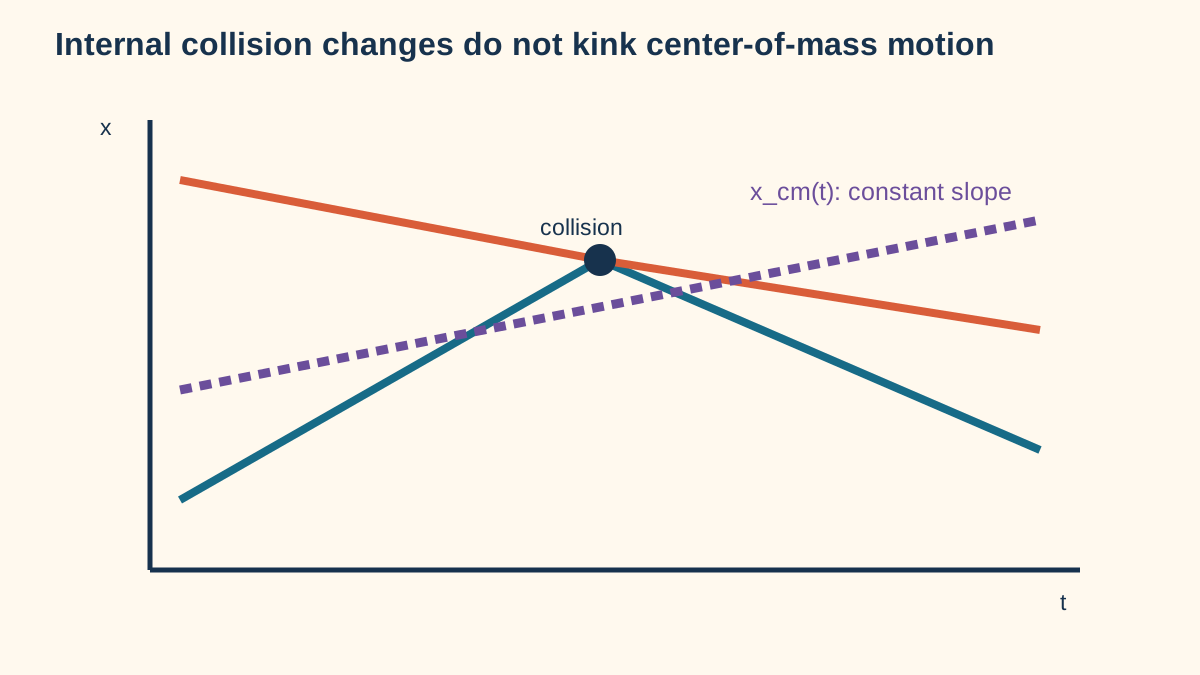
Internal interaction forces change individual velocities but not when external impulse is negligible.
All collision analyses begin with system and external impulse. If external impulse is negligible,
Additional conditions depend on evidence:
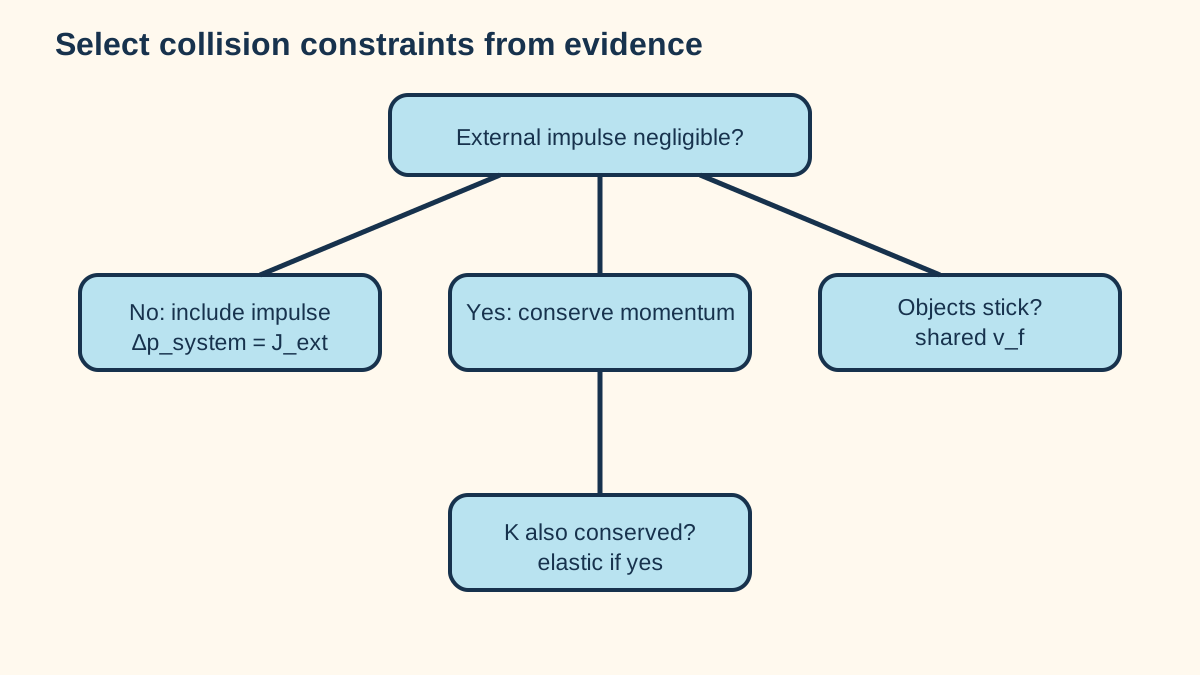
Define
Momentum is a vector; kinetic energy is a scalar. A collision can conserve momentum while kinetic energy transfers to thermal energy, sound, deformation, or rotation.
A cart at sticks to a cart at rest:
and . Momentum is conserved; leaves macroscopic translational kinetic energy.
The center-of-mass frame moves at . In a one-dimensional elastic collision, velocities relative to the center of mass reverse while retaining magnitudes. Transforming back gives lab-frame final velocities. This is a model insight, not a replacement for checking energy and momentum.
An explosion begins with stored internal energy. If initial system momentum is zero and external impulse negligible,
Pieces have equal and opposite momenta; the lighter piece has greater speed. Kinetic energy may increase as stored energy is released.
“Center of mass must be inside an object.” It can lie in empty space.
“The center of mass follows the largest object.” Its acceleration follows net external force.
“Every collision conserves kinetic energy.” Only elastic collisions do.
“Momentum is conserved for each object.” Interaction impulse changes individual momentum.
“An explosion violates momentum conservation.” Stored energy changes kinetic energy while total momentum remains controlled by external impulse.
The center of mass converts many-object motion into a system-level model. External force controls that point; collision details determine how momentum and energy are distributed internally.
Does the center of mass move at approximately constant velocity during different two-cart collisions when external impulse is small?
Teacher supervision is required. Secure a low-friction track with soft stops, use low-speed carts, keep hands/feet clear, inspect bumpers and couplers, and place cameras outside the path. Do not use projectiles, heavy carts, or modified springs.
Low-cost alternative: two low-mass toy carts on a marked smooth floor.
Simulation alternative: approved collision simulation with exported position-time data.
Center-of-mass velocity and system momentum should remain approximately constant within uncertainty, while kinetic energy changes more in sticking collisions.
Claim whether center-of-mass motion supported negligible external impulse. Cite slopes, momentum, energy, and uncertainty.
Offer safety, camera, tracking, data, graphing, uncertainty, and narration roles. Use high-contrast markers and screen-reader tables. Analysis may use shared/simulated data.
Transform measured velocities into the center-of-mass frame and test whether elastic-like collision velocities approximately reverse.