Lesson reading
live
5 min
Start with the lesson question, connect the representations, and test the model with evidence.
Inspect the opening phenomenon
Predict what changes, then name the evidence.
Apply in the lab
Name the evidence before reading the answer.
Read only what helps
Then use the lab and recall check.
More when needed
Transcript and resources stay available below.
Course progress
Vectors and Two-Dimensional Motion
Decision challenge
Use the opening example to make a prediction, identify evidence, and explain which model supports it.
Predict whether a dropped ball or horizontally launched ball reaches the floor first from the same height.
Predict which ball lands first, calculate the shared flight time, and test what changes when horizontal speed doubles.
Before
Predict whether a dropped ball or horizontally launched ball reaches the floor first from the same height.
During
Pause after the 1.80-meter height appears and calculate the shared flight time before the result is revealed.
After
Explain what doubles and what stays unchanged when horizontal launch speed doubles.
Lesson reading
live
5 min
Video script
draft
Transcript fallback
available
courses/ap-physics-1/modules/01-kinematics/lessons/03-vectors-and-two-dimensional-motion/video-transcript.md
Test the Shared-Time Projectile Model
draft
1 hr 15 min
Mastery check
live
7 questions / 18 min
# Transcript Two balls leave the same table together. One drops. One launches sideways. Which lands first? Sideways speed feels like extra airtime, but gravity only cares about the vertical motion. For the horizontal launch, horizontal velocity stays constant. Vertically, both balls start with zero vertical velocity and accelerate downward at g. Same height, same vertical model, same clock. From one point eight meters, time equals the square root of two h over g, or zero point six one seconds. At three point zero meters per second sideways, the projectile travels one point eight two meters, but still lands with the dropped ball. At the top of an angled path, only vertical velocity is zero. Horizontal velocity remains. Double the horizontal speed: what doubles, and what stays the same? Learn the full vector method free at EduQuest AI.
Reading lab
Connect the lesson's words, diagrams, graphs, evidence, and equations.
How can one curved path be predicted by two simpler motions?
At the same instant, one ball is dropped and an identical ball is launched horizontally from the same height. Ignore air resistance. Which reaches the floor first? Sketch both paths and explain what evidence would change your mind.
Gravity changes vertical velocity whether the object also moves sideways or not. A projectile's curved path is the combination of constant horizontal velocity and accelerated vertical motion.
For a vector of magnitude at angle above the positive horizontal axis,
The signs come from the chosen axes, not from the trigonometric function alone. Reconstruct the vector with
then use the component signs to select the correct quadrant.
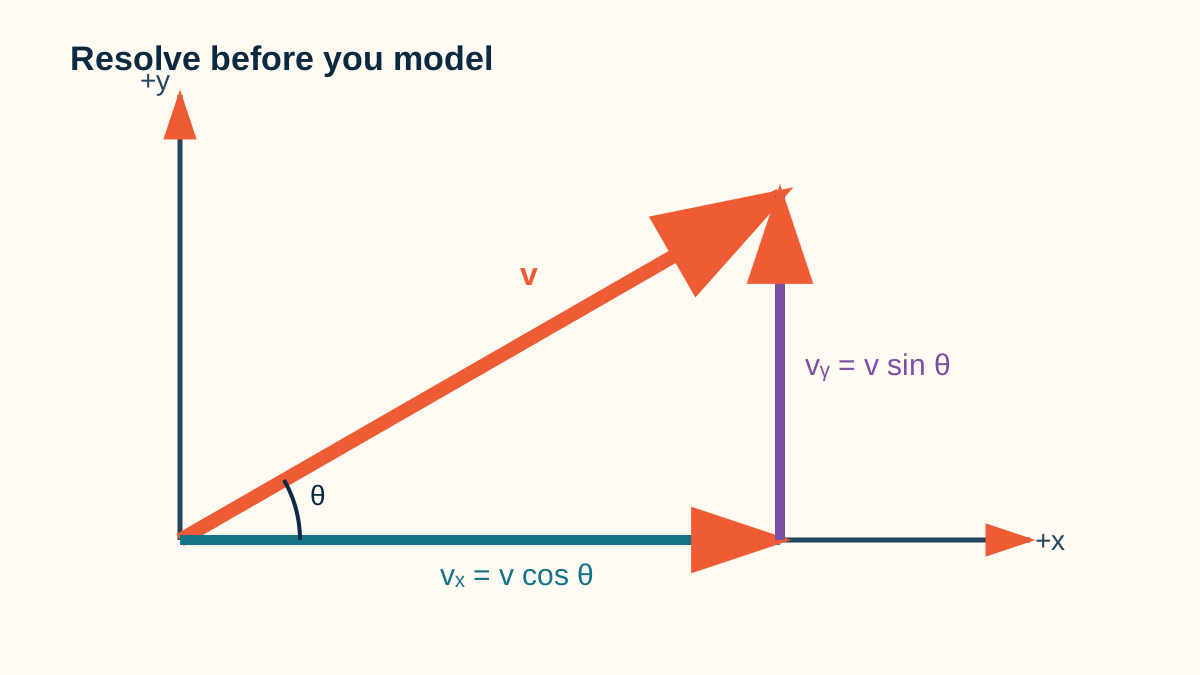
A ball leaves a launcher at and above horizontal:
The magnitude check gives .
Choose positive horizontally and positive upward. With negligible drag,
Therefore,
The components evolve independently, but they share the same time . That shared clock reconnects them into one trajectory.
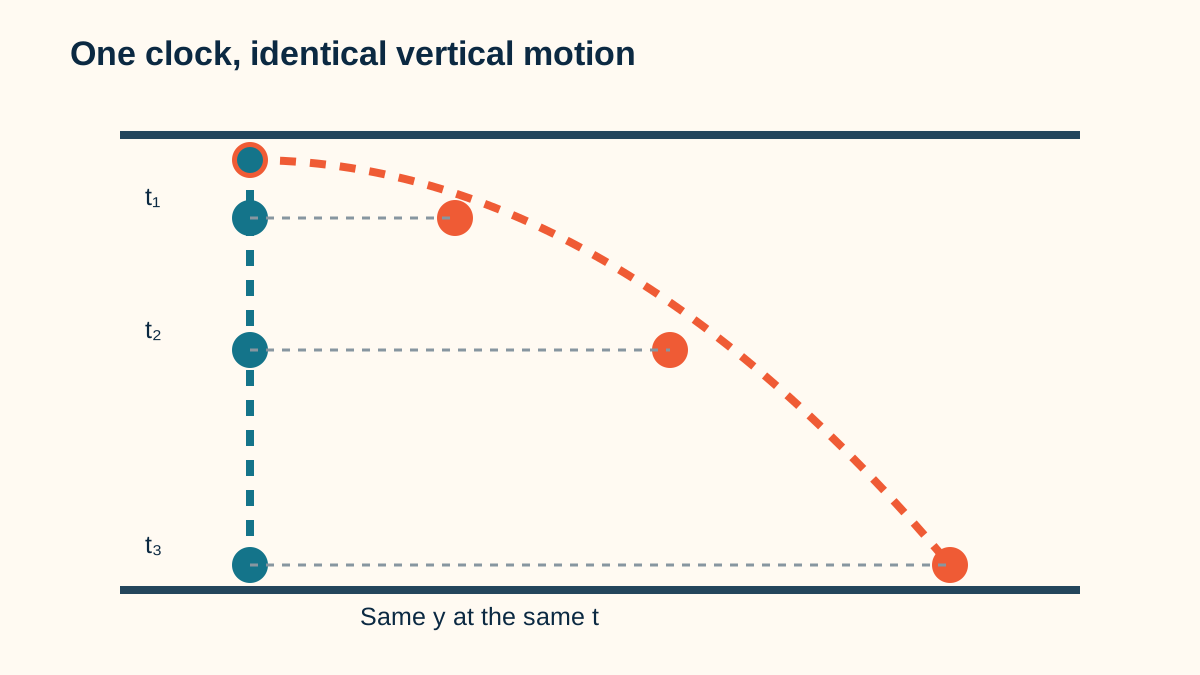
A ball rolls horizontally from a table at . Take the launch point as and upward as positive.
Vertical motion determines flight time:
so
Horizontal displacement is then
At impact,
The impact-speed magnitude is
At the highest point of an angled projectile, for an instant, but is still nonzero when drag is negligible. The acceleration is still downward: .
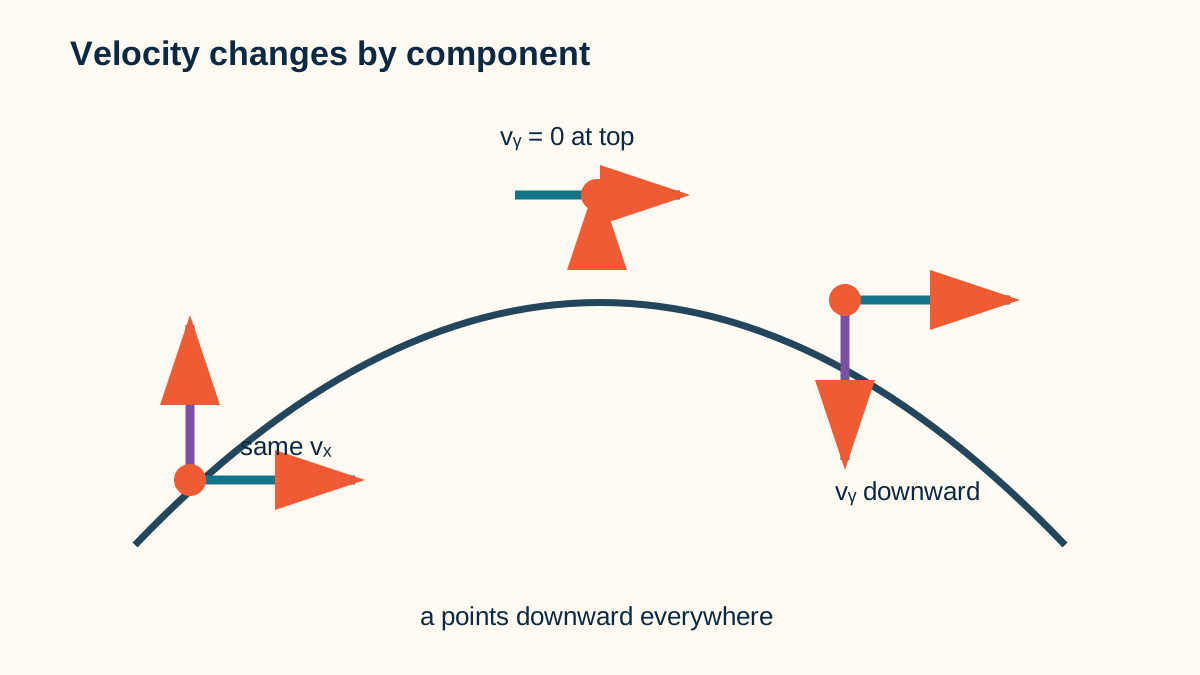
The simple projectile model assumes negligible air resistance, nearly constant , and a flat-Earth scale small enough that Earth's curvature is irrelevant. Drag can change both components and break the constant- claim.
“A horizontal launch delays the fall.” Horizontal velocity does not change the vertical acceleration in the ideal model.
“Velocity is zero at the top.” Only is zero; remains.
“The components are two different objects.” They are perpendicular descriptions of one vector.
“Acceleration points along the path.” In ideal projectile motion it points vertically downward.
“A negative component means slowing down.” It indicates direction relative to the chosen axis.
A curved projectile path becomes predictable when you resolve vectors, model horizontal and vertical motion separately, and reconnect them with their shared time.
Test whether horizontal launch speed changes flight time and evaluate a two-component projectile model with uncertainty.
Adult or teacher supervision is required. Use a soft foam ball or low-energy marble ramp. Keep the landing zone clear and away from faces, glass, electronics, stairs, and walkways. Do not launch projectiles toward people. Use floor padding and retrieve objects only after trials stop.
Measure launch height from the ball's center at release to the floor. Arrange a horizontal exit and mark the point directly below it. Define outward and upward.
| Trial | launch condition | (m) | (m/s) | measured (s) | range (m) | notes |
|---|---|---|---|---|---|---|
| 1 | slow | |||||
| 2 | slow | |||||
| 3 | fast | |||||
| 4 | fast |
Within uncertainty, slow and fast horizontal launches from the same height should have the same flight time when drag is negligible. The faster launch should have greater horizontal range.
Report measurement resolution, variation across trials, and at least one systematic limitation. Write a claim about flight-time independence, cite quantitative evidence, and connect the evidence to the separate-component model.
Use a simulation with keyboard controls and exported data if physical launching, reaching the floor, hearing impact, or frame-by-frame video work is inaccessible. Provide high-contrast markers, a partner role, and a text description of every visual observation.
Launch at a small upward angle, fit and separately, and test whether one shared time series explains both components.