Lesson reading
live
4 hr
Start with the lesson question, connect the representations, and test the model with evidence.
Inspect the opening phenomenon
Predict what changes, then name the evidence.
Apply in the lab
Name the evidence before reading the answer.
Read only what helps
Then use the lab and recall check.
More when needed
Transcript and resources stay available below.
Course progress
Power, Efficiency, and Energy Transfer
Decision challenge
Use the opening example to make a prediction, identify evidence, and explain which model supports it.
Predict whether two identical stair climbs completed in different times require the same average power.
Calculate gravitational energy and compare average power for five-second and ten-second climbs.
Before
Predict whether two identical stair climbs completed in different times require the same average power.
During
Pause after the 2352-joule energy change appears and calculate the five-second average power.
After
Explain why greater power does not necessarily mean greater total energy transfer.
Lesson reading
live
4 hr
Video script
draft
Transcript fallback
available
courses/ap-physics-1/modules/03-work-energy-and-power/lessons/02-power-efficiency-and-energy-transfer/video-transcript.md
Mechanical Power on a Stairway
draft
1 hr 10 min
Mastery check
live
7 questions / 15 min
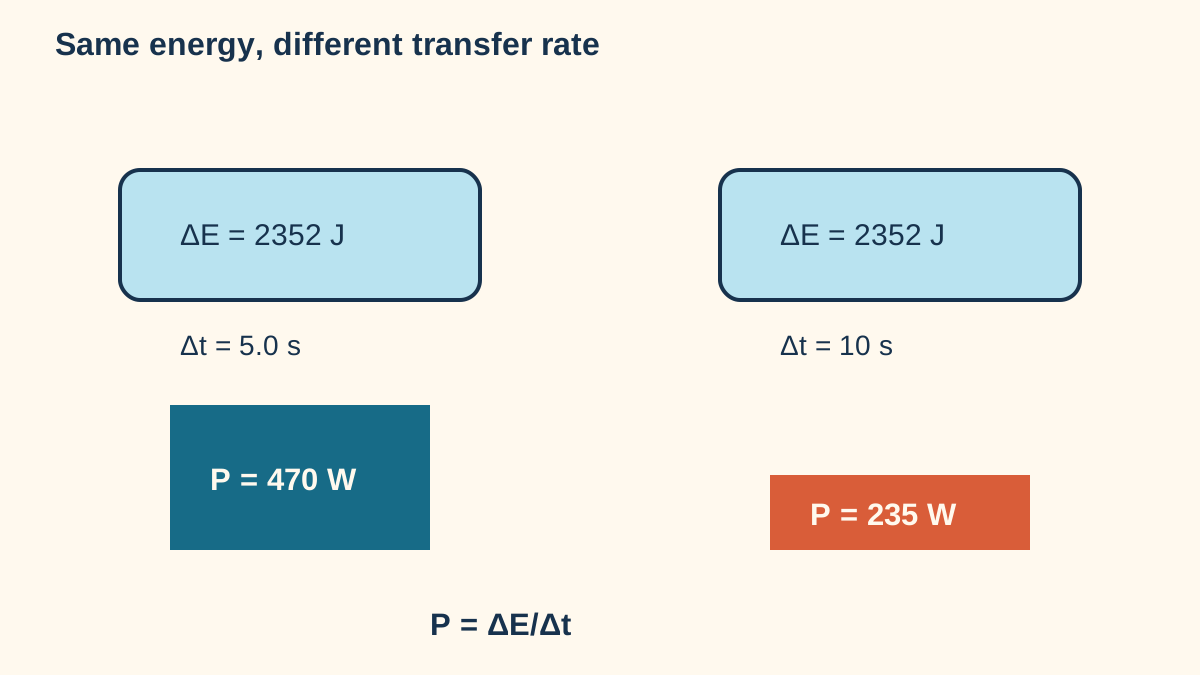
# Accessible transcript: Same Stairs, Different Power Same stairs, same energy—but not the same power. A sixty-kilogram student climbs four meters. Gravitational energy gained is m g h: two thousand three hundred fifty-two joules. Do it in five seconds. Average mechanical power is energy divided by time: about four hundred seventy watts. Take ten seconds and the energy is unchanged, but power is half as large. Quick check: does greater power always mean more total energy? Pause. No. Total energy also depends on how long power is delivered. Learn work and energy free at EduQuest AI. ## Visual description Two identical climbs show the same gravitational-energy bar but different timers. Dividing by five and ten seconds produces different power bars. A final prompt separates rate from total energy.
Reading lab
Connect the lesson's words, diagrams, graphs, evidence, and equations.
How quickly is energy transferred, and where does the transferred energy go?
Two students of equal mass climb the same stairs. They gain the same gravitational potential energy, but one takes half as long. Compare their work and power before calculating.
Power measures transfer rate, not total energy:
One watt is one joule per second. Completing the same energy transfer in half the time requires twice the average power.
For a constant force acting through displacement,
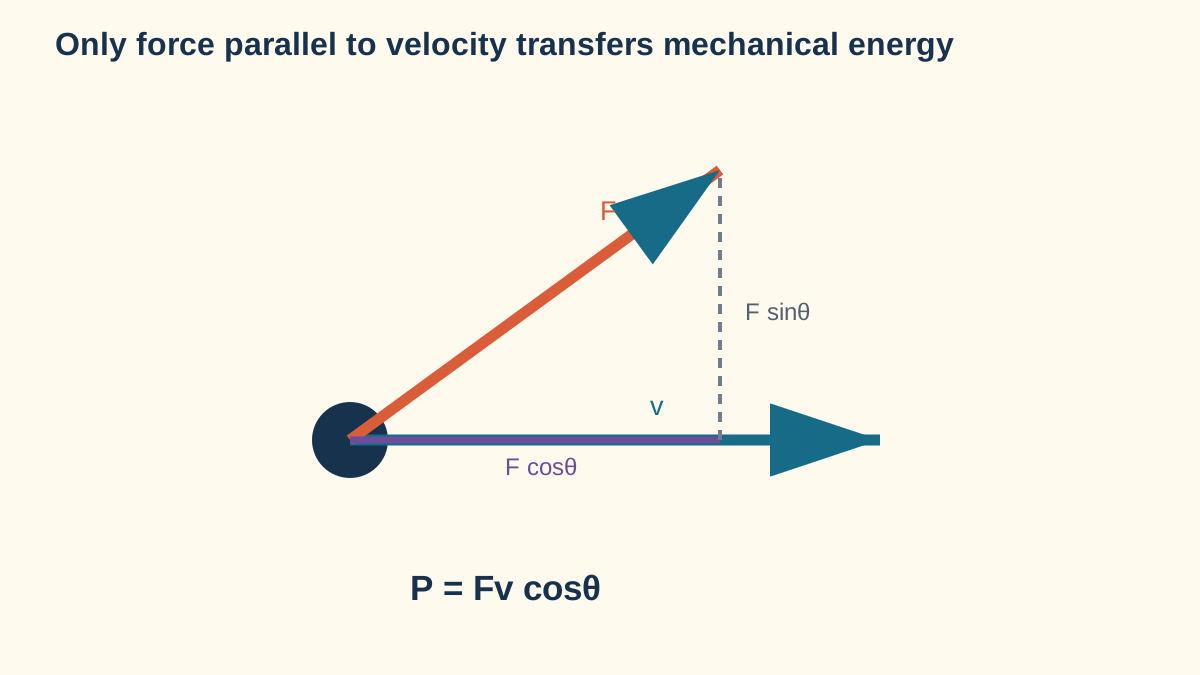
Instantaneous mechanical power is
Only the force component parallel to velocity transfers mechanical energy at that instant.
A student rises in at roughly constant speed:
This is mechanical output power associated with gravitational energy change, not total metabolic input power.
A motor pulls a cart with parallel to its velocity:
If the force is from velocity, power is . A perpendicular force can change direction while doing zero instantaneous work.
Efficiency is
for consistent intervals and steady operation. Report it as a decimal or percentage. It cannot exceed 100% for a complete, correctly defined passive/energy-converting system account.
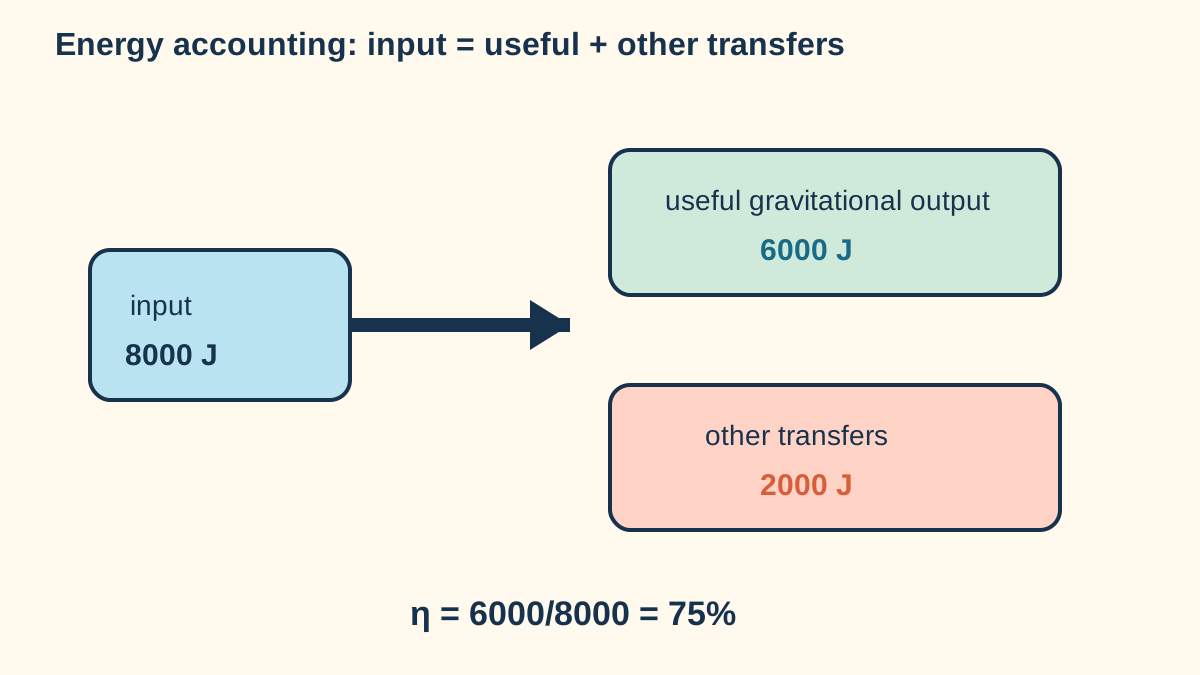
Energy is not “lost”; it becomes less useful for the chosen purpose, often transferred to thermal energy, sound, deformation, or fluid motion.
A lift receives electrical energy and increases a load's gravitational potential energy by :
The remaining is transferred to other stores/surroundings.
Efficiency depends on chosen input, useful goal, boundary, and interval. For a battery-powered motor, decide whether input means electrical energy delivered to the motor or chemical energy decrease of the battery. Both can be valid but answer different questions.
Since
slope of an energy-time graph is power. Signed area under a power-time graph is energy transferred:
A device can briefly exceed its long-duration rated power; model interval and thermal limits matter.
“Power and energy are interchangeable.” Power is energy transfer per time.
“A powerful device always uses more energy.” Total energy also depends on operating time.
“Inefficient energy disappears.” It transfers into other forms or surroundings.
“Efficiency can exceed 100% if output power is measured at a different time.” Mismatched intervals create an invalid comparison.
“Any force produces power .” Use the dot product and relevant force.
Energy accounting says how much transfers; power says how fast. Efficiency evaluates how much input serves a stated purpose without implying that the remainder disappears.
How does measured stair-climbing mechanical power depend on climb time while gravitational energy change remains approximately fixed?
Teacher supervision and participant consent are required. Use a dry, clear stairway with handrail, no running, no racing, one participant at a time, comfortable self-selected pace, appropriate mobility accommodations, and immediate stop for discomfort. Never pressure participation; provide a cart-lift or supplied-data alternative.
For the same person and height, gravitational energy change remains similar while shorter safe climb time corresponds to greater mechanical output power.
Claim how time affected measured mechanical power. Cite energy, times, powers, and uncertainty, then state model limitations.
Offer a tabletop motor/cart lift, simulation, or shared dataset as equivalent evidence. Roles include safety, measurement, timing, analysis, uncertainty, and narration. No physical stair use is required.
Use a safe small motor lifting a known load to estimate useful mechanical output power and, if electrical input data are safely available, efficiency.