Lesson reading
live
10 min
Start with the lesson question, connect the representations, and test the model with evidence.
Inspect the opening phenomenon
Predict what changes, then name the evidence.
Apply in the lab
Name the evidence before reading the answer.
Read only what helps
Then use the lab and recall check.
More when needed
Transcript and resources stay available below.
Course progress
Restoring Forces and Periodic Motion
Decision challenge
Use the opening example to make a prediction, identify evidence, and explain which model supports it.
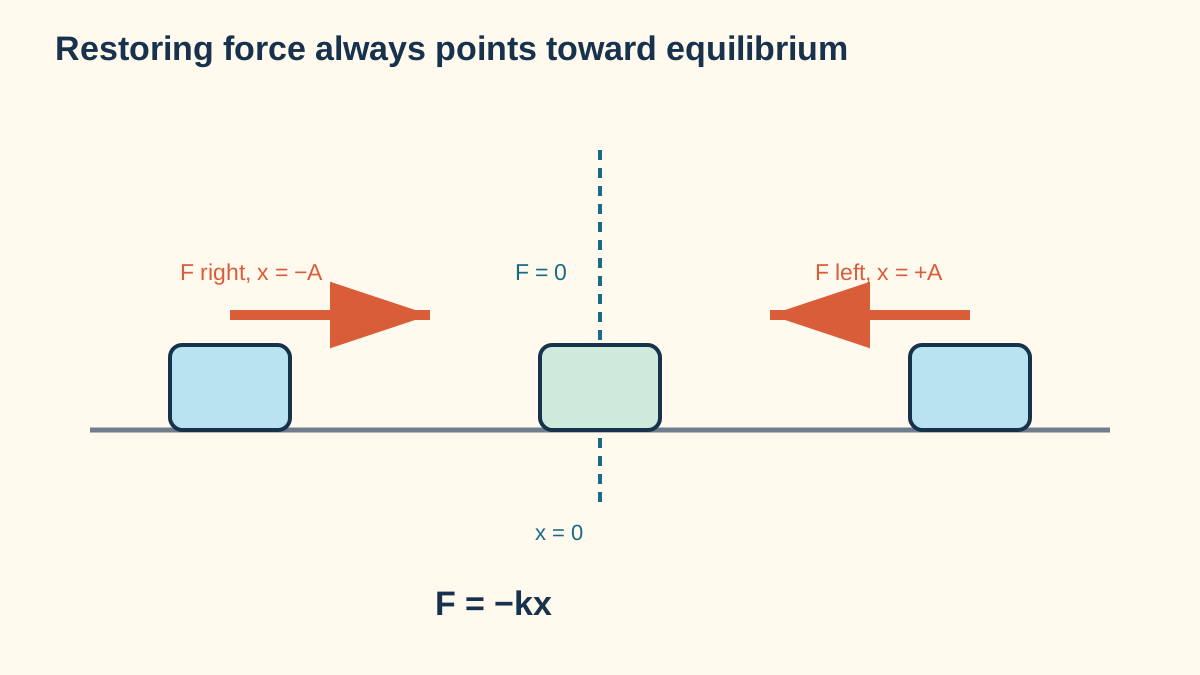
At maximum positive displacement, predict the directions and relative magnitudes of velocity, force, and acceleration.
Predict the acceleration at a turning point and test whether amplitude changes an ideal spring's period.
Before
At maximum positive displacement, predict the directions and relative magnitudes of velocity, force, and acceleration.
During
Track how force, acceleration, speed, spring potential energy, and kinetic energy change from endpoint to equilibrium.
After
Explain why doubling amplitude does not double the period of an ideal mass-spring oscillator.
Lesson reading
live
10 min
Video script
draft
Transcript fallback
available
courses/ap-physics-1/modules/07-oscillations/lessons/01-restoring-forces-and-periodic-motion/video-transcript.md
Test the Spring-Oscillator Period Model
draft
1 hr 25 min
Mastery check
live
7 questions / 15 min
# Accessible transcript: Zero Speed, Maximum Acceleration At a spring's turning point, speed is zero—but acceleration is greatest. At maximum positive displacement, the spring pulls hardest toward equilibrium: force equals negative k x. The block speeds up toward center. At equilibrium, force and acceleration are zero, but speed is maximum. Spring potential energy at the endpoint transforms into kinetic energy at the center. Quick check: if ideal amplitude doubles, does period double? Pause. No. Ideal spring period depends on mass and spring constant, not amplitude. Learn oscillations free at EduQuest AI. ## Visual description A block begins at maximum rightward extension with a large leftward restoring-force arrow, moves through equilibrium at maximum speed, and transfers spring potential energy into kinetic energy. A final prompt compares amplitude and period.
Reading lab
Connect the lesson's words, diagrams, graphs, evidence, and equations.
How do restoring interactions produce repeated motion?
A block on a spring reaches its rightmost point. Rank the magnitudes of displacement, velocity, acceleration, spring force, and kinetic energy at that instant. Then predict their values at equilibrium.
At an oscillation endpoint, velocity is zero for an instant—but the restoring force and acceleration are largest in magnitude. Confusing velocity with acceleration hides the mechanism that sends the object back.
Periodic motion repeats after a period ; frequency is
Simple harmonic motion (SHM) occurs when the net restoring force is proportional to and opposite displacement from equilibrium:
Newton's second law gives
where . The minus sign means acceleration points toward equilibrium.
One sinusoidal model is
Then
Position and acceleration are opposite in phase. Velocity is shifted by one-quarter cycle.
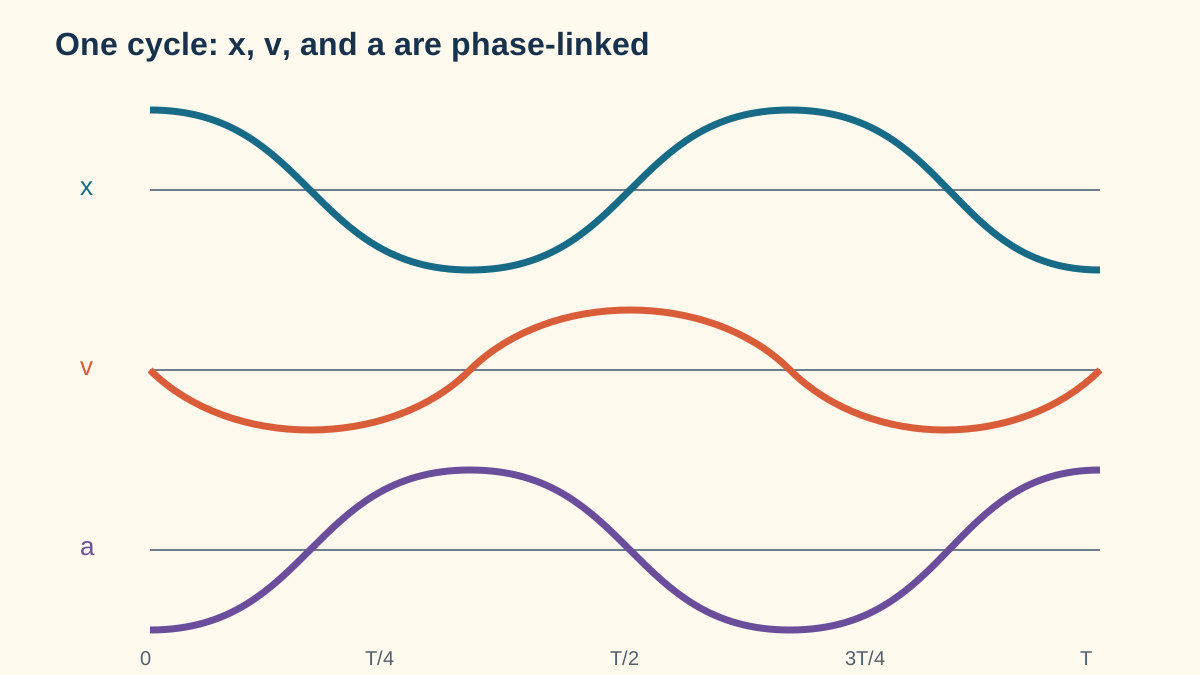
At , speed is zero and acceleration magnitude is maximum. At , acceleration is zero and speed magnitude is maximum.
For an ideal mass-spring oscillator,
Period increases with the square root of mass and decreases with the square root of spring constant. In the ideal model, period does not depend on amplitude.
A mass is attached to a spring:
Quadrupling mass doubles the period. Quadrupling halves it.
Mechanical energy is
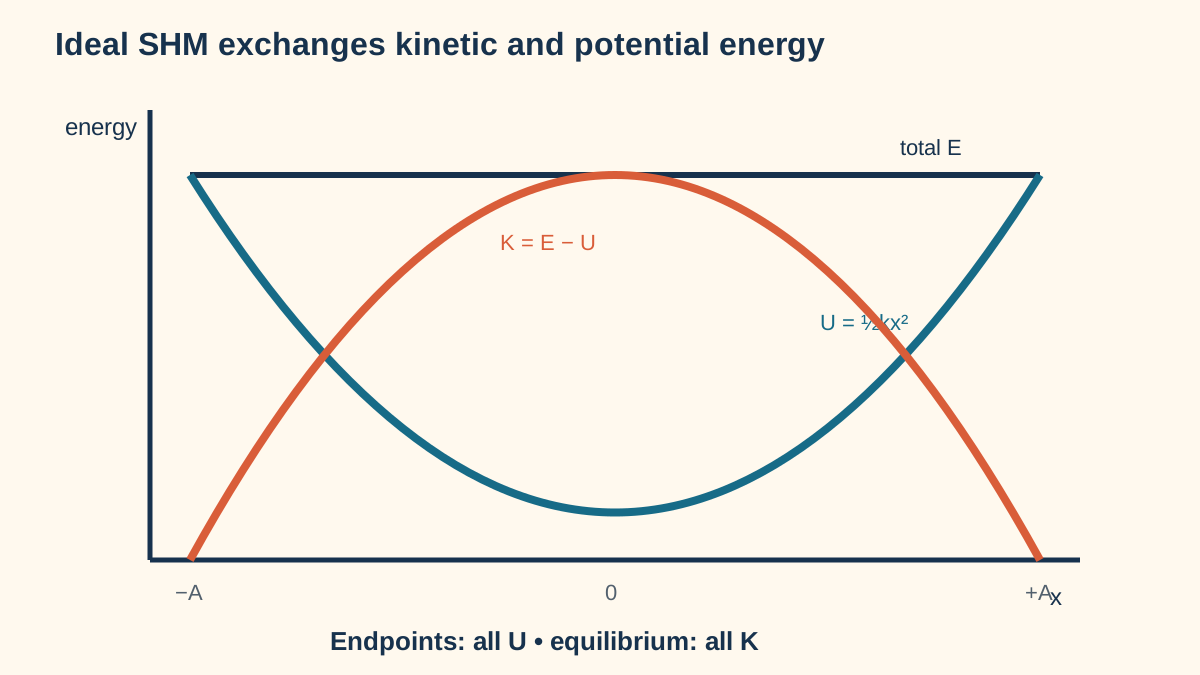
At endpoints, energy is entirely spring potential. At equilibrium, it is entirely kinetic. With damping, mechanical energy decreases and amplitude shrinks.
From energy conservation,
The two signs correspond to passing the same position in opposite directions.
For a simple pendulum of length at small angles,
The restoring torque is approximately proportional to angular displacement only when in radians. The ideal small-angle period does not depend on bob mass and is approximately amplitude independent. At larger amplitudes, the approximation weakens.
“Acceleration is zero at an endpoint.” Velocity is zero; acceleration magnitude is maximum.
“The oscillator moves at constant speed.” Speed changes continuously, reaching maximum at equilibrium.
“Larger amplitude always changes period.” Not for an ideal spring or small-angle ideal pendulum.
“The pendulum period depends on bob mass.” Mass cancels in the ideal small-angle model.
“Any repeating motion is SHM.” SHM specifically requires acceleration proportional to negative displacement.
SHM is produced by a linear restoring force. Force, phase, energy, and period are mutually consistent views of the same oscillation.
Does the measured spring-mass period follow , and is it independent of small amplitude within uncertainty?
Work under teacher supervision. Secure the support, wear eye protection if required, inspect the spring, use small masses, keep faces and feet away from hanging masses, add/remove mass only while supported, and place a catch tray below. Never exceed the spring's approved elastic range.
Low-cost alternative: a teacher-approved elastic element characterized over a verified linear range.
Simulation alternative: an approved spring simulation with exported data; identify omitted damping and measurement effects.
should be approximately proportional to mass, with slope near . Period should not change systematically with small amplitude within uncertainty.
Claim whether data support the period model. Cite fitted slope, intercept, uncertainties, and amplitude trials, then connect evidence to the restoring-force model.
Offer safety, tactile setup, release, timing, recording, graphing, uncertainty, and narration roles. Use high-contrast/tactile markers and screen-reader-friendly tables. Learners may analyze shared data without handling masses.
Use the fitted line to predict the period for one new safe mass, measure it, and evaluate agreement with uncertainty.