Lesson reading
live
4 hr
Start with the lesson question, connect the representations, and test the model with evidence.
Inspect the opening phenomenon
Predict what changes, then name the evidence.
Apply in the lab
Name the evidence before reading the answer.
Read only what helps
Then use the lab and recall check.
More when needed
Transcript and resources stay available below.
Course progress
Relative Motion and Reference Frames
Decision challenge
Use the opening example to make a prediction, identify evidence, and explain which model supports it.
Predict whether a passenger walking west inside an eastbound train can still move east relative to Earth.
Name the reference frame, chain the velocity subscripts, and reverse both vector and sign when the frame order reverses.
Before
Predict whether a passenger walking west inside an eastbound train can still move east relative to Earth.
During
Pause when the chained-subscript equation appears and calculate the passenger velocity relative to Earth.
After
Explain why reversing the reference-frame order reverses the relative-velocity vector.
Lesson reading
live
4 hr
Video script
draft
Transcript fallback
available
courses/ap-physics-1/modules/01-kinematics/lessons/04-relative-motion-and-reference-frames/video-transcript.md
Measure Relative Velocity on a Moving Platform
draft
1 hr 15 min
Mastery check
live
7 questions / 15 min
# Accessible transcript: Two Correct Velocities The same passenger can move west and east at the same time. She walks west at one point five meters per second relative to the train. But the train moves east at twelve relative to Earth. Passenger relative to Earth equals passenger relative to train plus train relative to Earth: negative one point five plus twelve. That's positive ten point five meters per second—east relative to Earth. Quick check: what is the train's velocity relative to the passenger? Pause. One point five meters per second east. Reverse the subscripts, reverse the vector. Learn relative motion free at EduQuest AI. ## Visual description An eastbound train carries a passenger walking west inside. Labeled velocity arrows and a chained subscript equation show why the passenger is still moving east relative to Earth. The final arrow reversal demonstrates opposite relative velocities.
Reading lab
Connect the lesson's words, diagrams, graphs, evidence, and equations.
How can observers report different velocities for the same object and still agree on the physics?
A passenger walks toward the front of a train at relative to the train. The train moves east at relative to Earth. Predict the passenger's velocity relative to Earth and the train's velocity relative to the passenger. Label every velocity with both objects.
A passenger tosses a ball straight upward inside a smoothly moving train. To the passenger, it returns along a vertical line. To an observer beside the track, it follows a forward-moving arc. The descriptions differ because position and velocity depend on the reference frame.
Write for “velocity of relative to .” For ordinary speeds far below light speed, Galilean velocity addition gives
Reversing the order reverses the vector:
Subscripts prevent the most common mistake: adding velocities that do not form a valid chain.
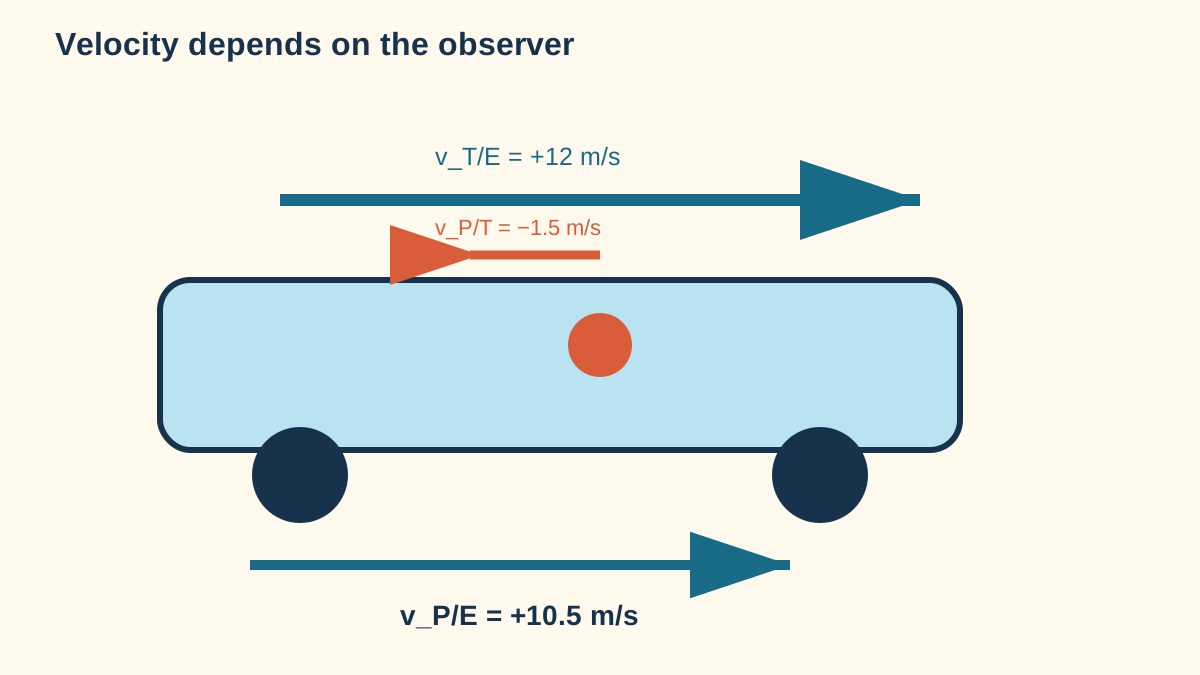
Choose east positive. A passenger walks west at relative to a train moving east at relative to Earth:
The passenger moves west relative to the train but east relative to Earth.
For translating frames,
Differentiating gives relative velocity. Differentiating again gives
Frames moving at constant velocity relative to one another agree on acceleration in Galilean mechanics. A frame accelerating or rotating relative to an inertial frame is non-inertial; applying Newton's laws there requires extra care.
Vectors must be added by components. For a boat,
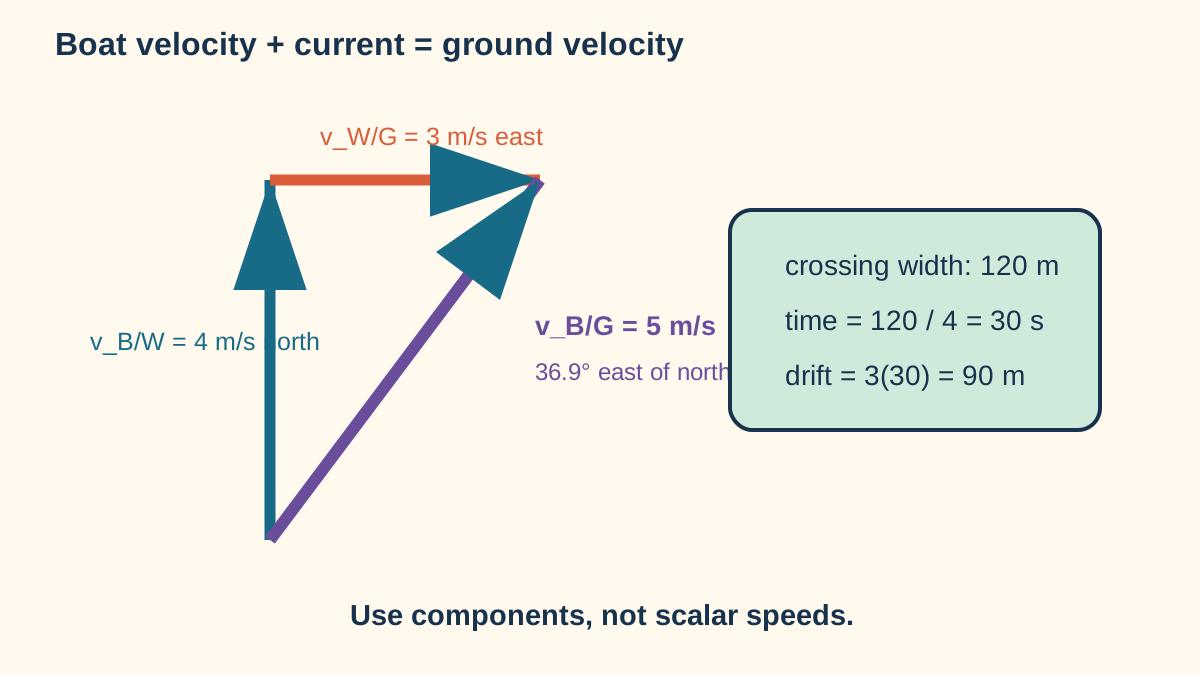
A boat moves north at relative to water while the current moves east at relative to ground. Then
Its ground speed is and it travels east of north. Across a river, crossing time depends on the north component:
so downstream drift is .
To eliminate downstream drift, the boat's water-relative velocity must have an upstream component equal and opposite the current. This changes the across-river component and therefore the crossing time.
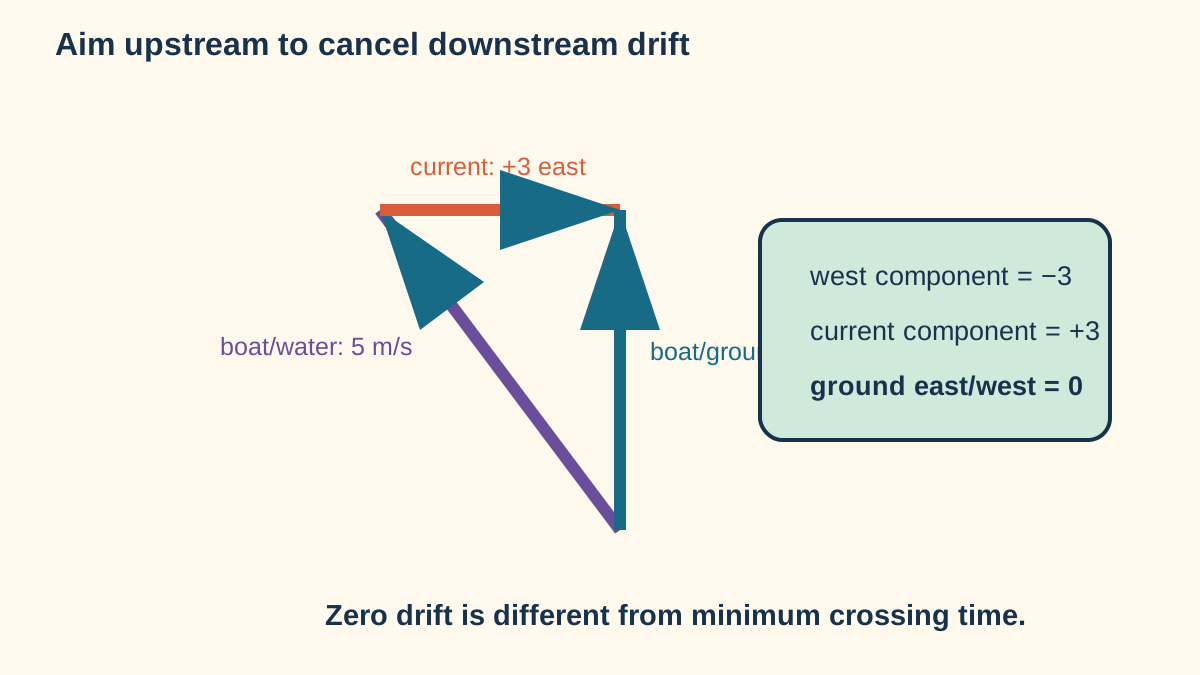
If boat speed relative to water is and current is east, choose . Then , so ground velocity is due north at .
An inertial frame is one in which an object with zero net force has constant velocity. A car turning, accelerating, or braking is not inertial. Earth is often treated as approximately inertial for short classroom-scale motion, although it rotates and orbits.
Galilean transformations apply when relative speeds are much smaller than the speed of light. Relativistic transformations are outside this lesson's scope.
“An object has one true velocity.” Velocity is relative to a frame.
“Relative speeds always add as scalars.” Velocities are vectors; signs and components matter.
“A current changes the boat's across-water speed.” It changes ground velocity; the boat/water vector is set by propulsion and heading.
“The fastest ground speed gives the shortest crossing time.” Crossing time depends on the perpendicular component.
“Earth is perfectly inertial.” It is often a useful approximation, not exact.
Velocity is frame-dependent, but consistent vector transformations let observers translate their descriptions and agree on predictions.
Does measured velocity obey within uncertainty?
Work under teacher supervision. Use a slow, stable cart or motor-free platform on a level track with soft stops. Keep hands, clothing, and feet clear; do not ride the platform; mount no heavy objects; place cameras outside the path; stop if motion is erratic.
Low-cost alternative: toy cart carrying a marble in a shallow guided channel, at very low speed.
Simulation alternative: approved relative-motion simulation with exported positions in two frames.
The measured object/ground velocity should agree with the signed sum of object/platform and platform/ground velocities within uncertainty.
Claim whether data support Galilean velocity addition. Cite fitted slopes, discrepancies, and uncertainty, then connect them to the frame-chain model.
Offer safety, setup, camera, marker, data, graphing, uncertainty, and narration roles. Use high-contrast/tactile markers and screen-reader tables. Learners may analyze shared data without operating carts.
Predict a trial in which object/ground velocity is approximately zero, then test it safely and evaluate agreement.