Lesson reading
live
15 min
Start with the lesson question, connect the representations, and test the model with evidence.
Inspect the opening phenomenon
Predict what changes, then name the evidence.
Apply in the lab
Name the evidence before reading the answer.
Read only what helps
Then use the lab and recall check.
More when needed
Transcript and resources stay available below.
Course progress
Pressure, Buoyancy, and Flow
Decision challenge
Use the opening example to make a prediction, identify evidence, and explain which model supports it.
Predict how fluid speed changes when a steady incompressible stream enters a pipe section with half the cross-sectional area.
Predict the narrow-section speed and identify the assumptions needed to compare static pressure.
Before
Predict how fluid speed changes when a steady incompressible stream enters a pipe section with half the cross-sectional area.
During
Pause at the area and speed values. Use area one times speed one equals area two times speed two before the result appears.
After
Explain why greater speed implies lower static pressure only when Bernoulli's steady ideal-flow assumptions and height are accounted for.
Lesson reading
live
15 min
Video script
draft
Transcript fallback
available
courses/ap-physics-1/modules/08-fluids/lessons/01-pressure-buoyancy-and-flow/video-transcript.md
Test Archimedes' Principle by Displacement
draft
1 hr 25 min
Mastery check
live
7 questions / 15 min
# Accessible transcript: Why Fluid Speeds Up in a Narrow Pipe Why does water speed up when a pipe narrows? For steady incompressible flow, the same volume must cross every section each second. Area one is four square centimeters at two meters per second. Area two is half as large, so continuity makes speed twice as large: four meters per second. At equal height in ideal flow, Bernoulli says that greater speed comes with lower static pressure. Quick check: does faster fluid always mean lower pressure? Pause. No. That conclusion needs steady, ideal flow and height accounting. Learn fluids free at EduQuest AI. ## Visual description A horizontal streamtube narrows from four to two square centimeters. Equally spaced flow-volume markers move twice as fast in the narrow section. Pressure gauges show lower ideal static pressure there, followed by an assumptions warning.
Reading lab
Connect the lesson's words, diagrams, graphs, evidence, and equations.
How do pressure, density, flow, and energy models explain fluid behavior?
Predict which statement is correct: (1) water pressure depends on container shape, (2) a floating object's buoyant force exceeds its weight, or (3) fluid speeds up in a narrower pipe. Explain each prediction before calculating.
For steady incompressible flow, the same volume must pass each cross-section per time. A smaller area means greater speed—not because fluid “wants” to accelerate, but because mass is conserved.
Density is
Pressure is normal force per area:
Pressure is a scalar measured in pascals, . Pressure is not force; force on a flat surface requires pressure and area.
In a fluid at rest of approximately constant density,
is vertical depth below the reference surface. At the same depth in the same connected fluid, pressure is the same regardless of container shape.
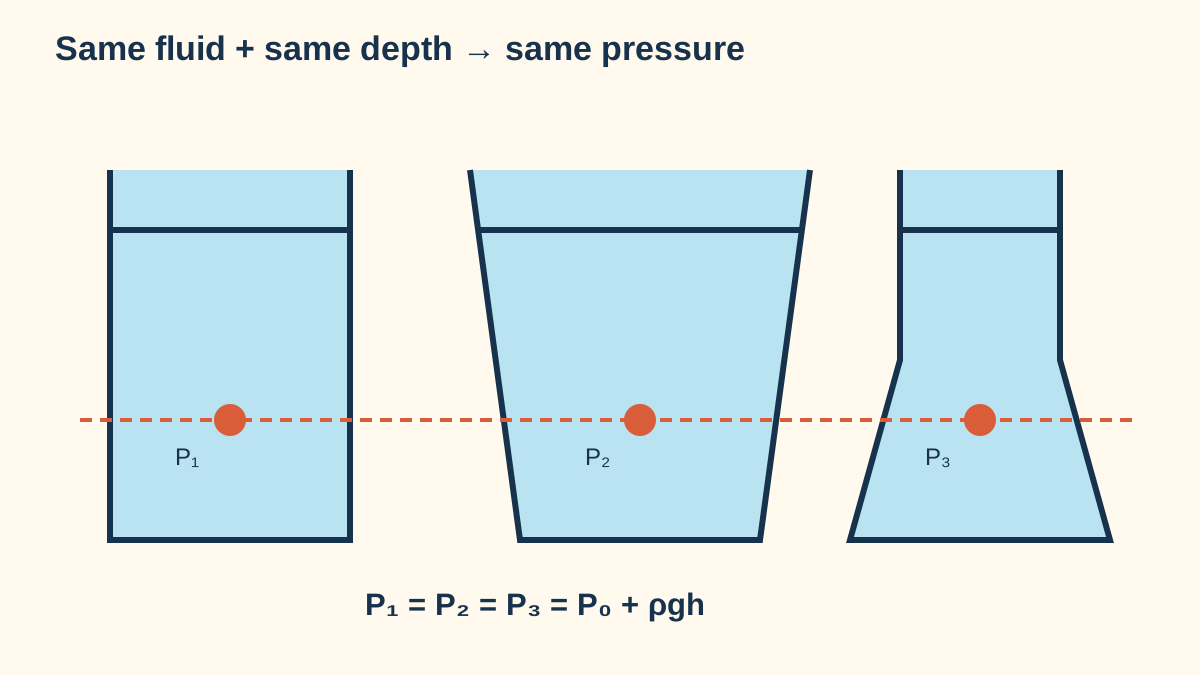
At below a freshwater surface, gauge pressure is
Absolute pressure adds atmospheric pressure; gauge pressure does not.
An externally applied pressure change in an enclosed fluid is transmitted throughout the fluid. For ideal pistons at the same height,
Force can be multiplied, but energy cannot: the larger piston moves a smaller distance so ideal input and output work agree.
Pressure increases with depth, so a submerged object typically experiences a larger upward pressure force on its bottom than the downward force on its top. The resulting buoyant force equals the weight of displaced fluid:
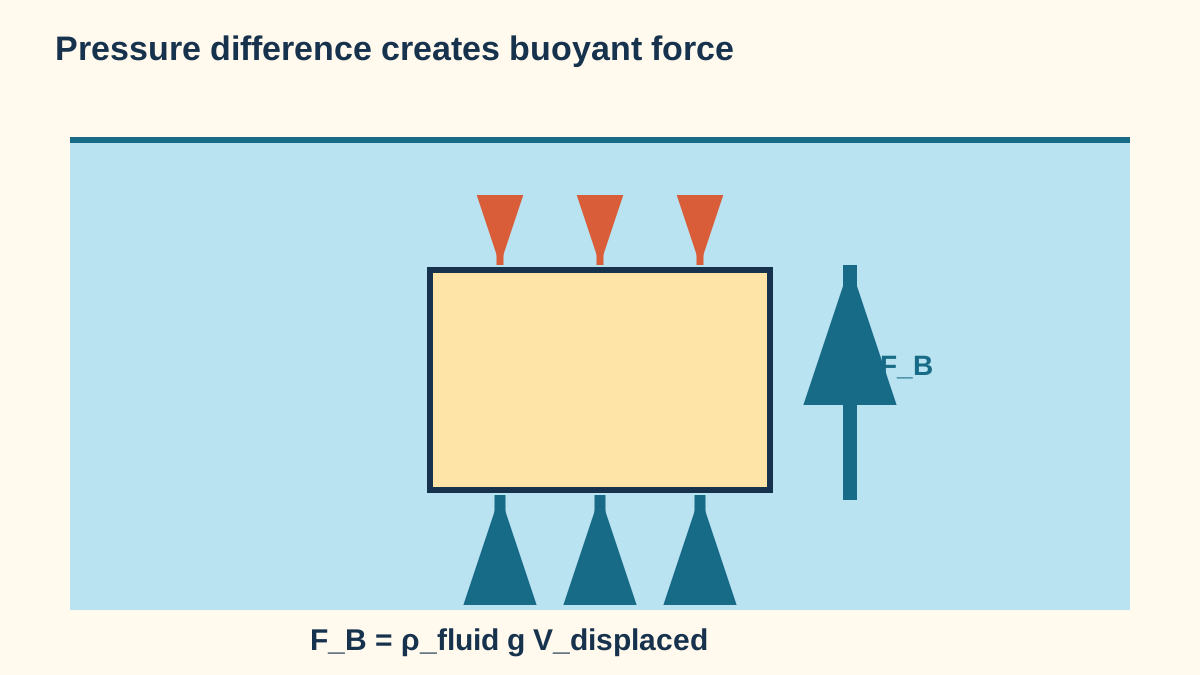
For a floating object in equilibrium,
The displaced volume adjusts until this is true. Buoyant force does not always equal object weight: a held submerged object or accelerating object can have other forces.
A block of density floats in water of density . Force balance gives
so
Seventy-five percent of its volume is submerged.
For steady incompressible flow,
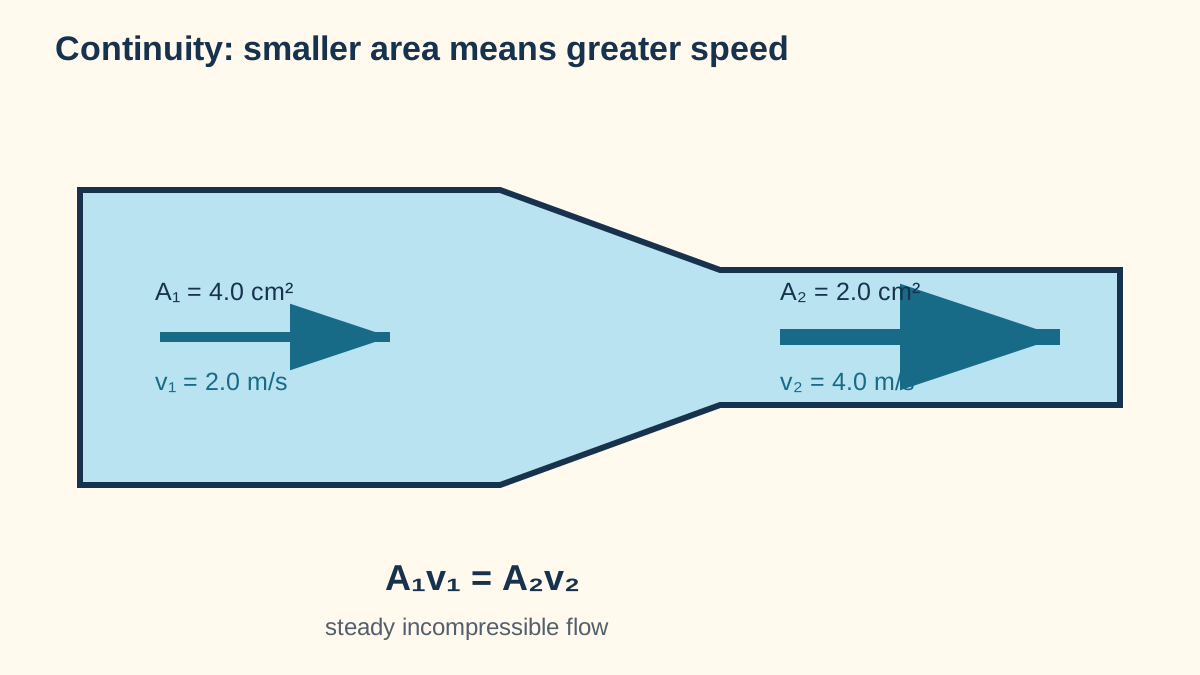
If pipe area halves, speed doubles. This relationship alone does not determine pressure.
For steady, incompressible, nonviscous flow along a streamline with no pump/turbine energy added or removed,
At equal height in this ideal model, greater speed corresponds to lower static pressure. “Faster fluid always has lower pressure” is too broad: height, viscosity, pumps, unsteady flow, and streamline choice matter.
Water flows from area at into area . Continuity gives . At equal height,
“Pressure is a force.” Pressure is force per area.
“Deeper pressure depends on container shape.” Hydrostatic pressure depends on depth, density, gravity, and surface pressure.
“Buoyant force always equals object weight.” That equality applies to vertical equilibrium with buoyancy and weight as the only vertical forces.
“A larger object always floats.” Average density and displaced-fluid capacity matter, not size alone.
“Faster fluid always has greater pressure.” Under restricted ideal equal-height conditions, faster flow corresponds to lower static pressure.
Fluid behavior follows force, mass, and energy accounting. Pressure fields explain buoyancy; continuity constrains flow speed; Bernoulli connects pressure, speed, and height only under stated ideal conditions.
Does the loss of apparent weight of a submerged object equal the weight of displaced water within uncertainty?
Work under teacher supervision. Use only water and nonreactive, nonsharp, low-mass objects. Keep water away from outlets/electronics, wipe spills immediately, use a stable container below eye level, never taste lab water, and wash hands afterward. Do not submerge powered devices.
Low-cost alternative: calibrated elastic force scale, kitchen measuring cup, and digital kitchen balance in a spill tray.
Simulation alternative: approved buoyancy simulation with raw readings; identify omitted surface tension, sensor, and spill losses.
The apparent-weight loss should agree with displaced-water weight within experimental uncertainty.
Claim whether evidence supports Archimedes' principle. Cite paired buoyant-force estimates and uncertainties, then link pressure difference to displaced-fluid weight.
Offer spill safety, tactile object inspection, scale reading, collection, recording, analysis, and oral-report roles. Use large-print/high-contrast scales and screen-reader tables. Analysis may use shared data without water handling.
Predict the submerged fraction of a safe floating object from its measured mass and external volume, then measure the fraction and compare within uncertainty.