Lesson reading
live
5 min
Start with the lesson question, connect the representations, and test the model with evidence.
Inspect the opening phenomenon
Predict what changes, then name the evidence.
Apply in the lab
Name the evidence before reading the answer.
Read only what helps
Then use the lab and recall check.
More when needed
Transcript and resources stay available below.
Course progress
Friction, Springs, and Connected Systems
Decision challenge
Use the opening example to make a prediction, identify evidence, and explain which model supports it.
Predict the friction force on a resting box pushed with 12 newtons when its maximum static friction is 30 newtons.
Predict the needed static friction, distinguish the maximum from the actual value, and identify the sliding regime.
Before
Predict the friction force on a resting box pushed with 12 newtons when its maximum static friction is 30 newtons.
During
Pause when the inequality appears and explain why it uses less-than-or-equal rather than equals.
After
State the static friction on a resting box with no horizontal applied force and justify your answer.
Lesson reading
live
5 min
Video script
draft
Transcript fallback
available
courses/ap-physics-1/modules/02-force-and-translational-dynamics/lessons/03-friction-springs-and-connected-systems/video-transcript.md
Measure Static and Kinetic Friction
draft
1 hr 20 min
Mastery check
live
7 questions / 15 min
# Accessible transcript: Static Friction Is Not Always Maximum Static friction is not automatically mu-s times normal force. Push a box with twelve newtons. If it stays still, static friction is twelve newtons back—even if its maximum is thirty. Static friction matches the push only up to its limit: mu-s N. Exceed that threshold and sliding begins. During sliding, use kinetic friction: mu-k N. It can be smaller than the peak static value. Quick check: a resting box has no horizontal push. What is static friction? Pause. Zero. Static friction supplies only what is needed, up to a maximum. Learn forces free at EduQuest AI. ## Visual description A box remains at rest while applied force and opposing static friction arrows grow together. A graph rises to maximum static friction, then transitions to a lower kinetic-friction level. The final zero-push case shows zero static friction.
Reading lab
Connect the lesson's words, diagrams, graphs, evidence, and equations.
How do contact forces, elastic interactions, and connection constraints shape a system's motion?
A box rests on a rough floor while a horizontal pull slowly increases from zero. Sketch friction magnitude versus applied-force magnitude from rest through slipping. Then predict what changes at the instant sliding begins.
Push a heavy box gently and it stays at rest because static friction matches the push. It increases only as needed, up to a limit:
Once surfaces slide, the model becomes
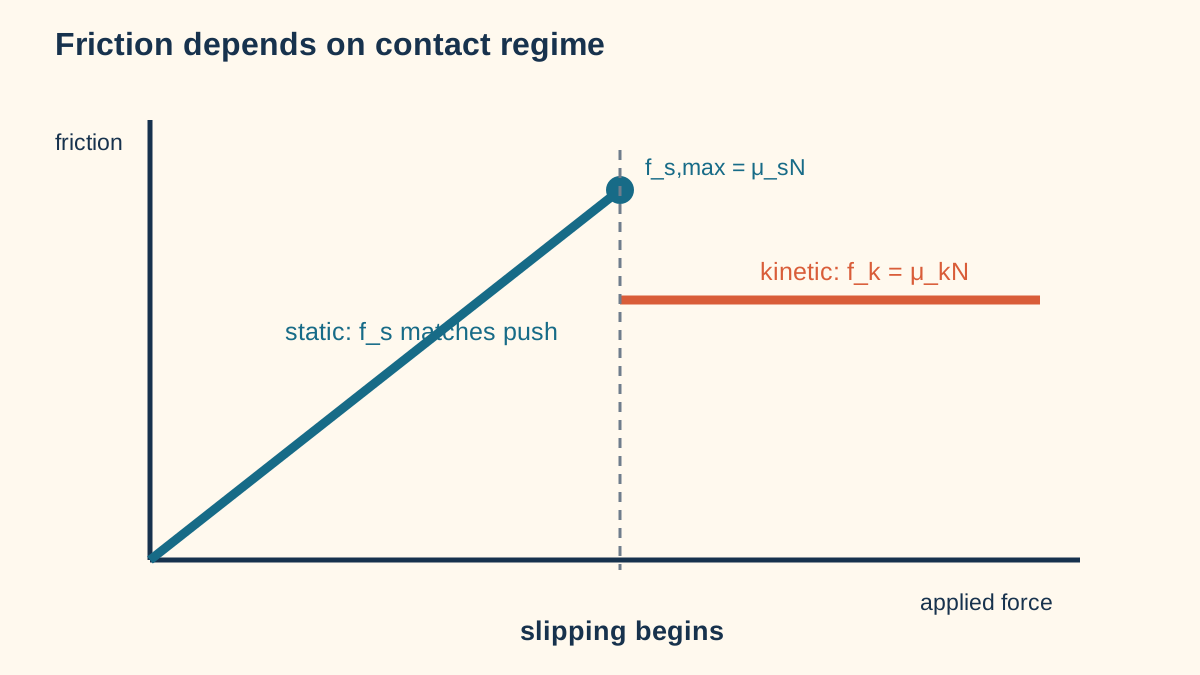
Friction opposes relative slipping or its tendency, not necessarily the object's velocity.
is not automatically . For a horizontal pull angled upward by with no vertical acceleration,
so . An upward pull reduces normal force and therefore reduces the maximum or kinetic friction predicted by these models.
A crate slides on a level floor with while pulled horizontally by . Using ,
For an ideal spring near equilibrium,
is displacement from the spring's relaxed/equilibrium reference appropriate to the model. The negative sign indicates restoring direction. A force-extension graph has slope magnitude within the linear range.
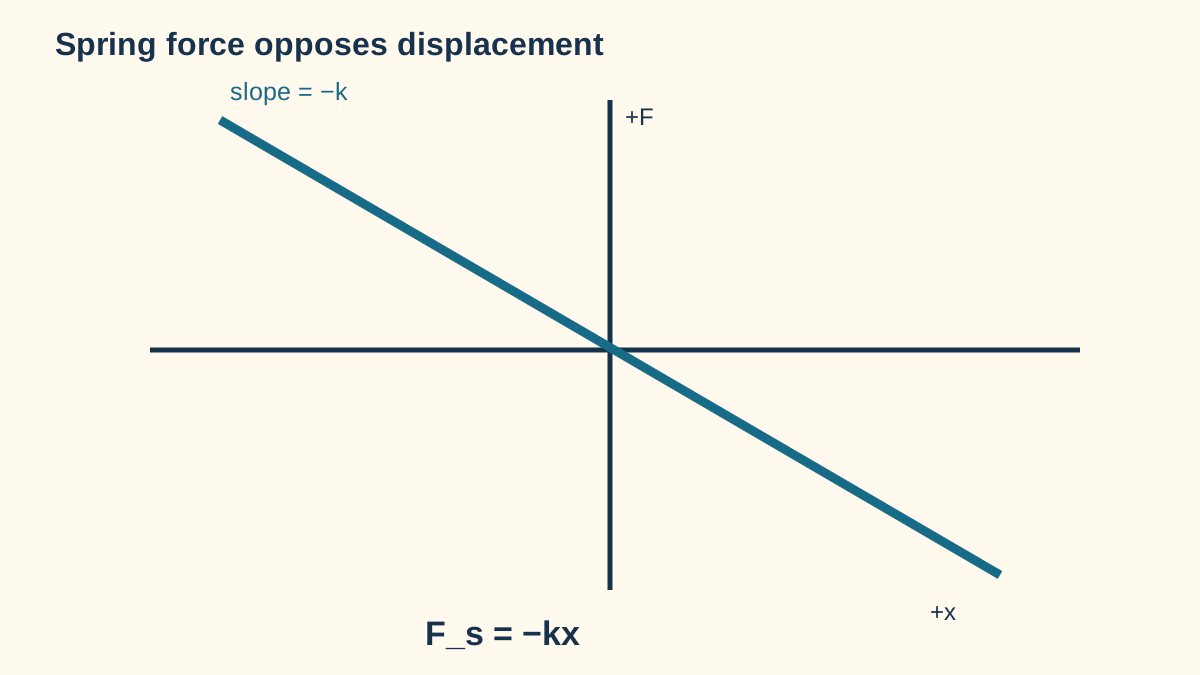
A spring with is stretched . Its force magnitude is toward equilibrium. If attached to a block on a frictionless surface at that instant,
This instantaneous acceleration changes as changes.
For an ideal light inextensible string over an ideal pulley, connected objects have related acceleration magnitudes. Tension is uniform in the ideal string, but it is not generally equal to either object's weight.
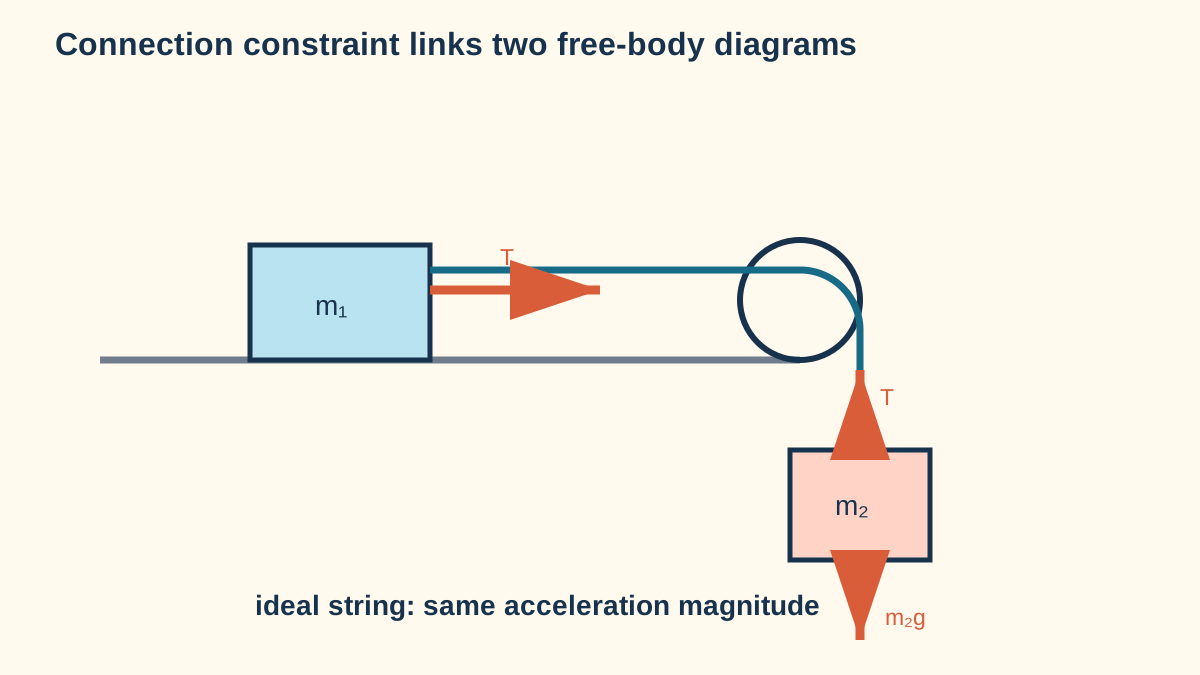
For mass on a frictionless table connected to hanging mass :
Adding eliminates internal tension:
Then .
Let and :
Tension is less than the hanging weight because the hanging mass accelerates downward.
If slides with kinetic friction,
provided the assumed direction is correct and . If the calculated acceleration has the opposite sign, revisit the assumed motion and whether static friction prevents movement.
“Static friction always equals .” That is only its maximum.
“Friction always opposes velocity.” It opposes relative slip or tendency to slip.
“Normal force always equals weight.” Other perpendicular forces/acceleration matter.
“Tension equals the hanging weight.” Only when that mass has zero acceleration.
“Spring force is constant.” It changes with displacement in Hooke's-law range.
Friction and spring forces require conditional models; connected motion adds constraints. Clear system choice turns their internal interactions into solvable equations.
How do maximum static friction and kinetic friction depend on normal force for two chosen surfaces?
Work under teacher supervision. Use low masses, inspect force sensors/string, keep the pull path clear, add masses only while supported, use a catch tray, and pull horizontally at low speed. Do not use sharp, fragile, or overhead loads.
Low-cost alternative: luggage scale and sealed mass bags.
Simulation alternative: approved friction simulation with exported force data and stated idealizations.
Both graphs should be approximately linear over the tested range, with slopes estimating and ; commonly for the same surfaces.
Claim whether friction was proportional to normal force in the tested range. Cite slopes, intercepts, and uncertainty, then state limitations.
Offer safety, loading, sensor, recording, graphing, uncertainty, and narration roles. Use high-contrast/tactile mass labels and screen-reader tables. Analysis may use shared data.
Use fitted coefficients to predict whether one new approved applied force causes rest or sliding, then test safely.