Lesson reading
live
5 min
Start with the lesson question, connect the representations, and test the model with evidence.
Inspect the opening phenomenon
Predict what changes, then name the evidence.
Apply in the lab
Name the evidence before reading the answer.
Read only what helps
Then use the lab and recall check.
More when needed
Transcript and resources stay available below.
Course progress
Fluid Dynamics and Bernoulli Applications
Decision challenge
Use the opening example to make a prediction, identify evidence, and explain which model supports it.
Predict the speed change when a steady incompressible stream enters a pipe with half the area.
Predict the speed ratio, identify Bernoulli assumptions, and explain the ideal pressure-speed tradeoff.
Before
Predict the speed change when a steady incompressible stream enters a pipe with half the area.
During
Pause at the Bernoulli relationship and identify every assumption needed for the pressure-speed tradeoff.
After
Explain why reducing the area to one-third makes the ideal flow speed triple.
Lesson reading
live
5 min
Video script
draft
Transcript fallback
available
courses/ap-physics-1/modules/08-fluids/lessons/02-fluid-dynamics-and-bernoulli-applications/video-transcript.md
Efflux Speed and Fluid Height
draft
1 hr 15 min
Mastery check
live
7 questions / 18 min
--- lesson_slug: 02-fluid-dynamics-and-bernoulli-applications duration_seconds: 55 --- # Transcript Squeeze a steady water stream into half the area, and its speed doubles. For incompressible flow, area times speed stays constant: A-one v-one equals A-two v-two. The same volume must pass every cross-section each second. Along an ideal level streamline, pressure plus one-half rho v squared stays constant. If speed rises, static pressure falls—but only under Bernoulli's assumptions. Real viscosity, turbulence, pumps, or compressibility can change that simple tradeoff. Pause: area becomes one-third. What happens to speed? It triples. Explore the free AP Physics 1 fluids lesson at EduQuest AI.
Reading lab
Connect the lesson's words, diagrams, graphs, evidence, and equations.
How do area, speed, pressure, and height trade off as fluid moves?
Water flows steadily from a wide pipe into a section with half the cross-sectional area. Predict the new speed and whether continuity alone determines the pressure change.
For steady incompressible flow, the volume flow rate is constant:
If area halves, speed doubles. This follows from conservation of mass, not from Bernoulli's equation.
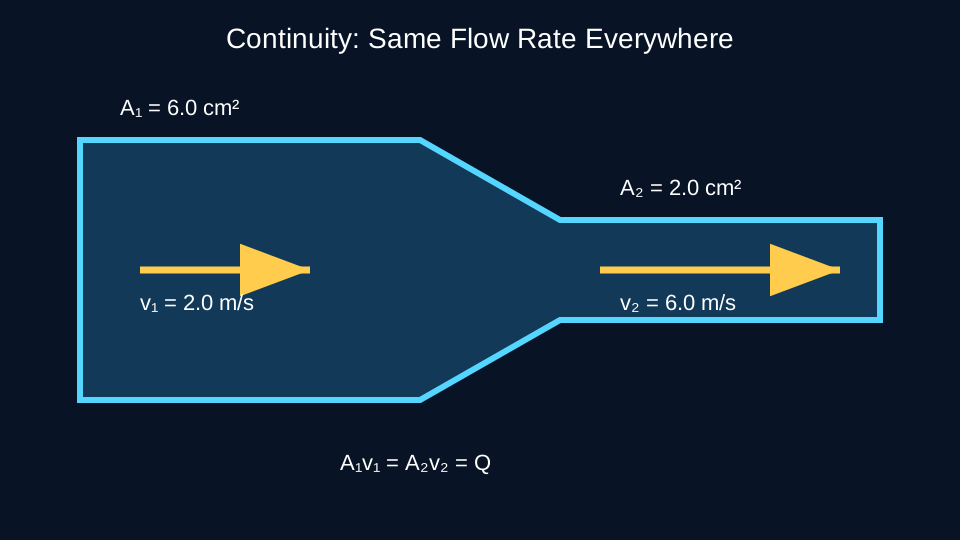
Water travels at through area and enters area :
The flow rate is .
For steady, incompressible, negligible-viscosity flow along one streamline with no pump or turbine work,
The terms represent pressure energy, kinetic energy, and gravitational potential energy per unit volume. At equal height, greater speed corresponds to lower static pressure under these assumptions.
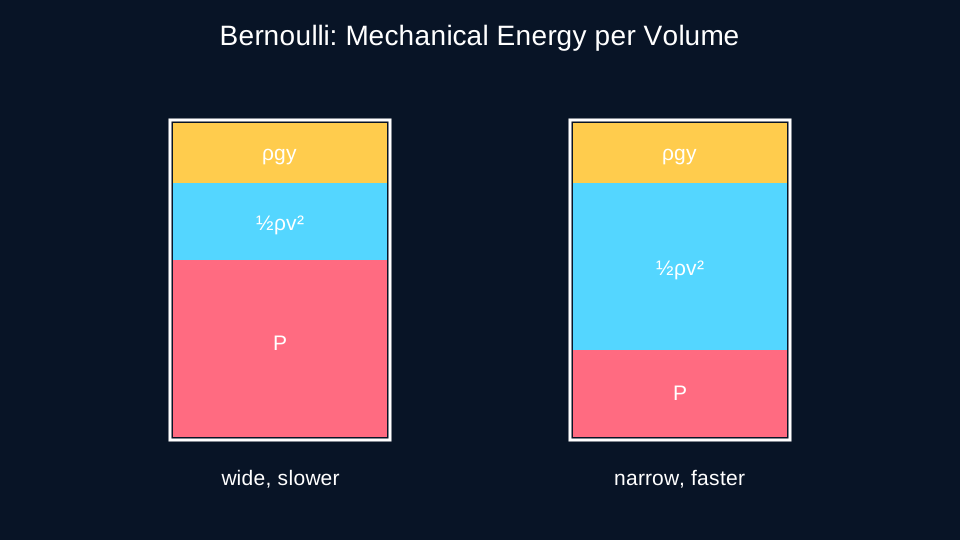
For water, , with and at equal height:
The faster narrow section has pressure lower by in the ideal model.
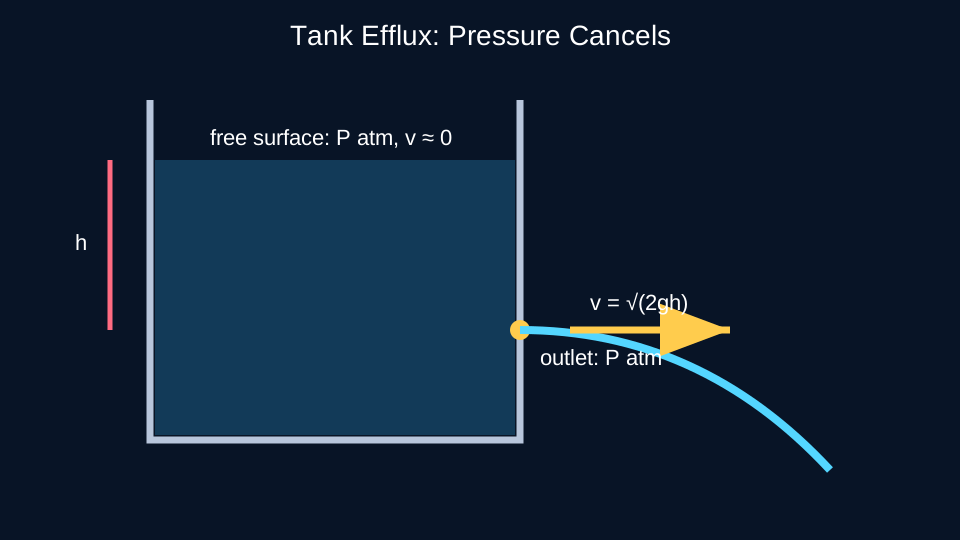
Apply Bernoulli between a large tank's free surface and a small outlet a vertical distance below. Both points are at atmospheric pressure, and the surface speed is negligible:
This is Torricelli's law. At , .
In a horizontal ideal pipe, area becomes one-third as large. By what factor does speed change? Which Bernoulli term must decrease?
A Venturi meter relates pressure difference to speed change through continuity plus Bernoulli. A Pitot tube compares stagnation pressure and static pressure. Real atomizers and aerodynamic systems involve streamline shape, viscosity, entrainment, circulation, and pressure fields; “faster fluid always means lower pressure” is not a universal rule.
A student says, “Air moving faster always has lower pressure.” Rewrite this as a scientifically defensible conditional statement and name two assumptions that matter.
Choose a system and streamline, mark areas and heights, apply continuity first, write Bernoulli with every retained term, use consistent pressure references, and check whether predicted losses or Reynolds effects make the ideal result implausible.
See sources.yaml. All examples, questions, and diagrams are original and do not imply College Board endorsement.
Test whether the horizontal exit speed from a small outlet follows over a safe range of water depths.
Work under teacher or responsible-adult supervision over a sink or waterproof tray. Use only a low-height plastic container and water; immediately wipe spills, keep electronics dry and elevated, and never seal or pressurize the container. Use blunt pre-made openings—students must not cut or puncture containers. Stop if the container becomes unstable or water reaches walking areas.
Accessible alternative: analyze a teacher-recorded high-contrast video and direct a partner's measurements.
Simulation alternative: use a teacher-approved fluid simulation and state idealizations.
The ideal model predicts a line through the origin with slope . Real speeds may be smaller because of viscosity, contraction at the outlet, changing water level, and uncertain landing position.
Fit versus , compare the slope with , inspect residuals, and calculate a discharge ratio . Explain uncertainty and systematic losses using claim-evidence-reasoning.
Predict the water head that maximizes horizontal range when the outlet and landing geometry are fixed, then test only within the approved spill-safe setup.