Lesson reading
live
5 min
Start with the lesson question, connect the representations, and test the model with evidence.
Inspect the opening phenomenon
Predict what changes, then name the evidence.
Apply in the lab
Name the evidence before reading the answer.
Read only what helps
Then use the lab and recall check.
More when needed
Transcript and resources stay available below.
Course progress
Rotational Kinematics and Moment of Inertia
Decision challenge
Use the opening example to make a prediction, identify evidence, and explain which model supports it.
Predict whether points at half-radius and full radius on one rigid wheel have the same tangential speed.
Compare wheel points at half and full radius, then apply the radius-squared inertia relationship.
Before
Predict whether points at half-radius and full radius on one rigid wheel have the same tangential speed.
During
Pause at the radius relation and calculate the outer-to-inner tangential-speed ratio.
After
Explain why moving a point mass to twice the radius makes its inertia contribution four times larger.
Lesson reading
live
5 min
Video script
draft
Transcript fallback
available
courses/ap-physics-1/modules/05-torque-and-rotational-dynamics/lessons/02-rotational-kinematics-and-moment-of-inertia/video-transcript.md
Test Rotational Inertia by Mass Distribution
draft
1 hr 25 min
Mastery check
live
7 questions / 15 min
# Accessible transcript: Same Wheel, Different Speeds Two points on one rigid wheel can have different speeds. Every point completes each revolution together, so points at half-radius and full radius share the same angular speed. But tangential speed equals radius times angular speed. The full-radius point moves twice as fast. Mass distribution matters too. Move a point mass to twice the radius and its moment-of-inertia contribution becomes four times larger. Quick check: do all wheel points share radial acceleration? Pause. No. Radial acceleration equals r omega squared, so it grows with radius. Learn rotation free at EduQuest AI. ## Visual description One wheel marks points at half-radius and full radius. Both sweep the same angle, while tangent arrows show the outer point moving twice as fast. A point mass then shifts outward, and its inertia bar quadruples.
Reading lab
Connect the lesson's words, diagrams, graphs, evidence, and equations.
How do angular motion and mass distribution determine the response of a rotating rigid body?
Mark one point at radius and another at radius on a rigid wheel. As it rotates, compare their angular displacement, angular velocity, linear distance, tangential speed, and radial acceleration.
Every point on a rigid wheel completes each revolution together, so all points share angular velocity. But a point farther from the axis travels a longer arc and moves faster linearly.
Angular displacement is measured in radians:
Angular velocity and acceleration are
Slope of is ; slope of is . Signed area under is angular displacement.
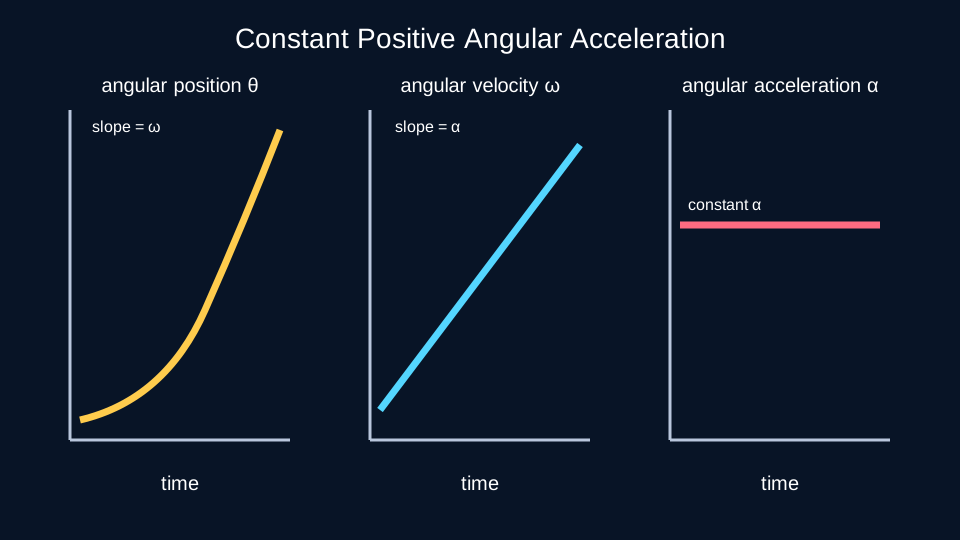
When is constant,
These equations mirror constant-acceleration translation but require radians and consistent signs.
A wheel starts at and accelerates at for :
For a rigid body,
and radial acceleration is
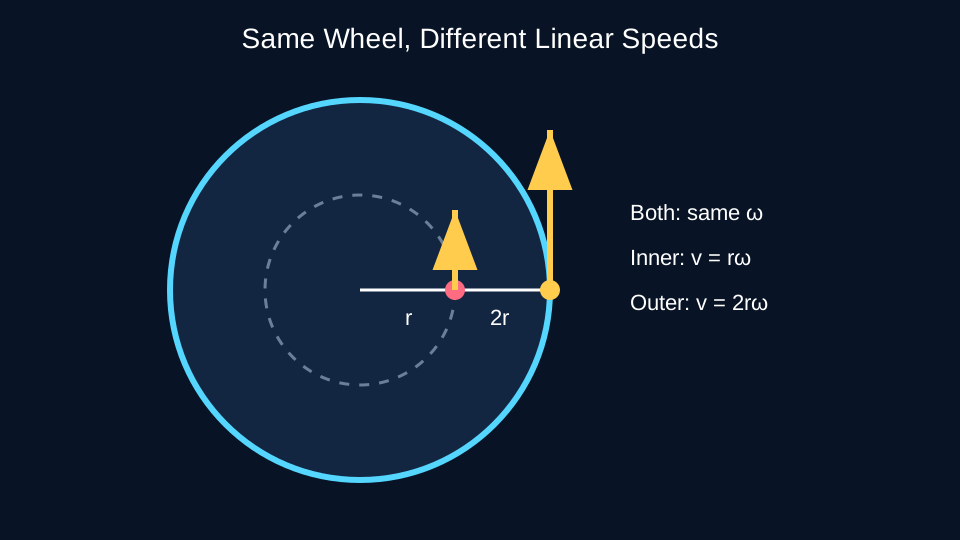
Tangential acceleration changes speed; radial acceleration changes direction. They are perpendicular components.
Rotational inertia measures resistance to angular acceleration about a stated axis:
for point masses. It depends on total mass, mass distribution, and axis. Units are .
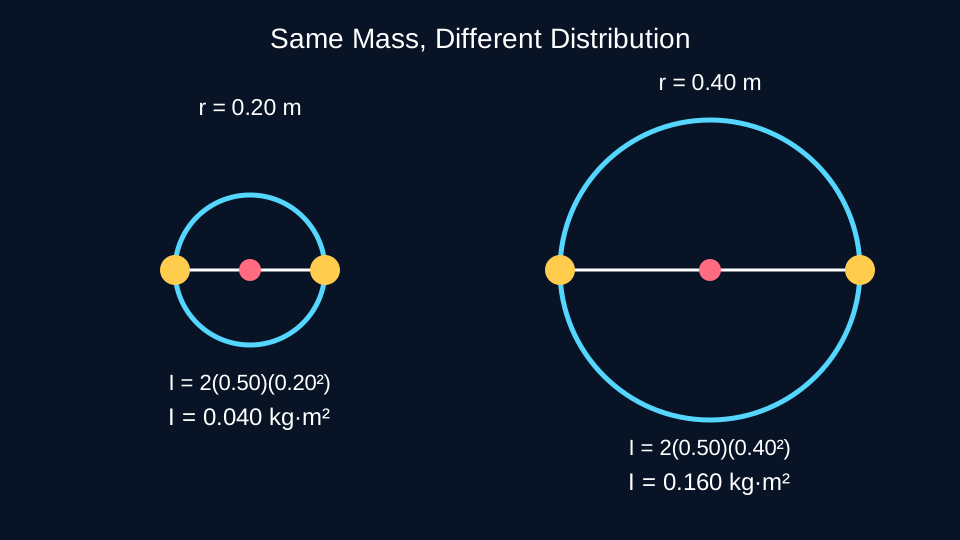
Two point masses are placed symmetrically at radius :
Moving them to makes , four times larger.
About central symmetry axes:
The model must match geometry and axis. A hoop has greater than a solid disk with the same and because more mass lies farther out.
Moving an axis away from the center of mass increases inertia:
Use this theorem only for parallel axes and a known center-of-mass-axis inertia.
For rolling without slipping,
for the tangential rolling acceleration relationship under appropriate conditions. Sliding breaks the constraint.
“All wheel points have the same linear speed.” They share ; .
“Moment of inertia depends only on mass.” Distribution and axis matter.
“Radians have no role because they are dimensionless.” They remain essential labels in angular interpretation.
“Tangential and radial acceleration are the same.” They change speed and direction, respectively.
“Rolling always means .” Only rolling without slipping satisfies it.
Rigid-body points share angular motion but not linear motion. Rotational inertia turns mass distribution and axis choice into a measurable resistance to angular acceleration.
For approximately equal applied torque, how does moving equal masses outward affect angular acceleration?
Teacher supervision is required. Use a commercial low-speed rotational platform with masses securely fastened, inspect clamps/strings, use a protective boundary, keep hair/clothing/hands clear, and stop before repositioning masses. Never spin handheld masses or operate with loose components.
Alternative: teacher-provided or simulation dataset when safe apparatus is unavailable.
Moving masses outward increases rotational inertia approximately with contribution and reduces angular acceleration for the same net torque.
Claim how distribution affected angular acceleration. Cite fitted slopes, ratios, and uncertainty, then connect to .
Offer safety, setup, measurement, sensor, data, graphing, uncertainty, and narration roles. Use tactile/high-contrast markers and screen-reader tables. Analysis may use shared/simulated data.
Use acceleration and known torque to estimate total inertia for both configurations and compare the difference with prediction.